What are plättar?
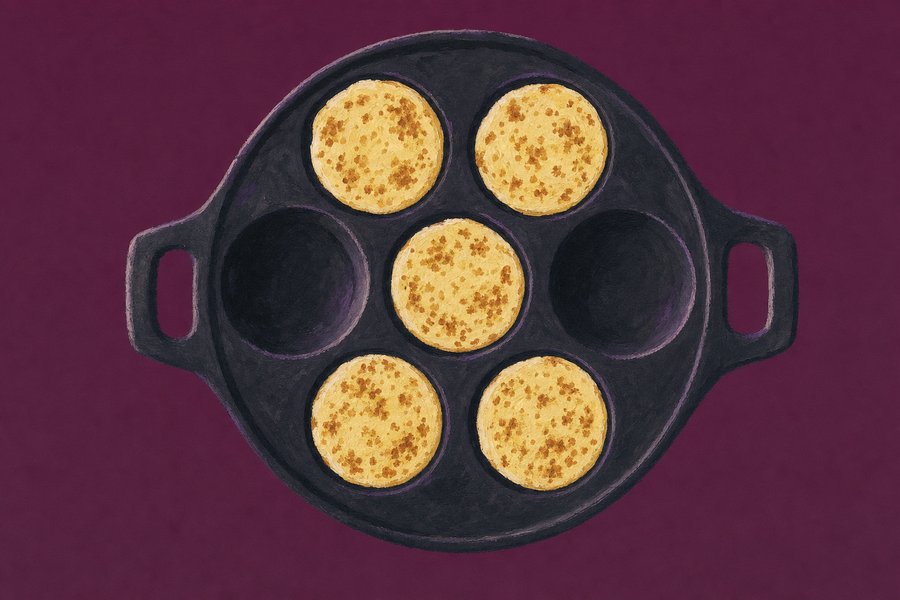
Plättar are small thin pancakes cooked in a plättlagg, a cast-iron pan with shallow round hollows set into it, usually seven, sometimes twelve, so that a batch cooks at once. The singular is plätt.
The pan is the reason they exist in this form. A plättlagg turns out seven at a time, which makes a small pancake practical to serve in quantity in a way that a frying pan does not. And the count is not incidental: a lagg of seven is conventionally counted as one portion, so the equipment defines the serving as well as the shape.
By convention the batter is a little richer than that for pannkakor, with more cream, more butter and more egg, from otherwise the same mixture. It is the same batter family made slightly more generous, not a different recipe.
The word is regional, and that is the finding
In standard Swedish the distinction is clean: plättar are the small ones made in a plättlagg, pannkakor are the large pan-sized ones, and an oven-baked one is ugnspannkaka. Southern usage names the dishes after the vessels they are cooked in: oven pan, frying pan, plättlagg. It is a tidy system.
It does not hold everywhere. Across parts of Småland, Skåne, Blekinge, Norrbotten and Västerbotten, and in Finland, everything cooked on the stovetop is called plättar regardless of its size. So the word does not reliably mean small, and a recipe titled plättar may produce either the seven-at-a-time kind or a full pan-sized pancake depending on who wrote it.
That is a regional split rather than a translation error, which makes it a different animal from the naming problems elsewhere on this site. Nobody is wrong, and there is no correct version to appeal to. The practical consequence is the same, though: check the pan the recipe assumes rather than trusting the title.
Thursday, pea soup, and pancakes
Plättar are traditionally the dessert after ärtsoppa, yellow pea soup, eaten on Thursdays. The pairing is fixed enough in Sweden to be a fixture of school and canteen menus rather than a family habit, and it is the main reason a small pancake is a savoury-meal accompaniment here rather than a breakfast.
The origin of the Thursday convention is not established on this page. Explanations circulate, most involving Friday fasting and the need for a substantial Thursday meal, and nothing consulted here documents one, so none is asserted. What is well attested is the pairing itself and its persistence.
Where it sits
Plättar are one of three thin-cake naming problems collected on this site, and the full table, including the flapjack that is an oat bar in Britain and a pancake in America, is at flapjack. The Breton pair, where one traditional pancake is wheat and the other has never contained any, is at gluten free crêpes. Cast-iron sizing and the rest of the equipment are in the kitchen section, the Nordic bakes are indexed at Nordic, and the Swedish terms are in the glossary.
Questions about plättar
What is the difference between plättar and pannkakor?
In standard Swedish, size and pan: plättar are small and made in a plättlagg, pannkakor are large and made in a frying pan. But across parts of Småland, Skåne, Blekinge, Norrbotten and Västerbotten, and in Finland, anything cooked on the stovetop is called plättar whatever its size.
What is a plättlagg?
A cast-iron pan with shallow round hollows set into it, usually seven and sometimes twelve, so that a batch of small pancakes cooks at once.
How many plättar are a portion?
One lagg, which conventionally means seven. The pan defines the serving as well as the shape.
Is the batter different from pannkakor batter?
By convention slightly richer, with more cream, butter and egg, from otherwise the same mixture. It is the same batter family made more generous rather than a different recipe.
Why are plättar eaten with pea soup on Thursdays?
The pairing with ärtsoppa is well attested and persistent, but its origin is not established here. Explanations circulate, most involving Friday fasting; nothing consulted documents one, so none is asserted.