What is kavring? Two answers, depending on the country
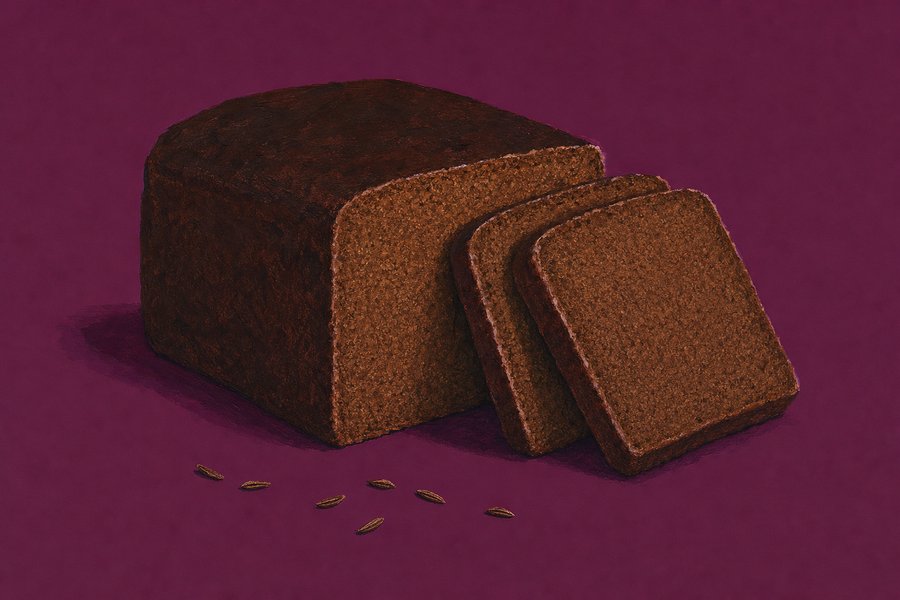
Of all the Swedish bread recipes worth knowing, this is the one whose name causes the most trouble: it means different things in Swedish and Norwegian, and that needs settling first. In Swedish, kavring is a dark, sweet, close-crumbed rye bread, originally from Skåne in the south. In Norwegian, kavring means a rusk: twice-baked, dry, hard, closer to a hardtack or a biscotti than to a loaf.
They are not variants of one product. Anyone arriving from a Norwegian search for kavring oppskrift is very likely after the rusk, and a kavring oppskrift in Norwegian will produce something dry and crisp rather than the dense sweet loaf described here. This page is about the Swedish bread.
In the Swedish sense it is an old bread: baked in southern and western Sweden at least since the late Middle Ages, with a name that is probably of Danish origin. It is sweetened with dark syrup and often made with filmjölk, soured milk, which contributes both acidity and tenderness at once. The crumb is close and slightly damp rather than open.
The Swedish rye bread: what is actually in it
The flour is the first thing that distinguishes it. A kavring is built on rågsikt, sifted rye blended with wheat, rather than on wholemeal rye. Historically barley flour and potato appear as well. Substituting straight rye flour for rågsikt gives a much denser, drier loaf, which is the single most common way the bread comes out wrong for people working from a translation.
The spicing is the second. The defining spices are kummin (caraway), anis, or pomerans: caraway, anise or bitter orange peel. And this is where a Swedish rye bread recipe most often fails in translation, badly enough to be worth its own heading.
Caraway seeds svenska: the trap that ruins the loaf
Swedish kummin is caraway. Swedish spiskummin, with the prefix, is cumin. Anyone looking up caraway seeds svenska needs kummin, and buying a jar labelled spiskummin gives cumin, which does not taste remotely like kavring and cannot be cooked out.
The trap is symmetrical, which is why it catches people in both directions. French cumin, Spanish comino and Dutch komijn all mean cumin, so anyone translating from those languages into Swedish reaches for the wrong jar unless they know about the prefix. Searching caraway seeds svenska and landing on spiskummin is the commonest version of the mistake. German Kümmel is caraway, adding a third pattern.
| English | Swedish | Botanical |
|---|---|---|
| caraway (seeds) | kummin | Carum carvi |
| cumin (seeds) | spiskummin | Cuminum cyminum |
| fennel (seeds) | fankal (fankalsfron) | Foeniculum vulgare |
| anise | anis | Pimpinella anisum |
| bitter orange (peel) | pomerans | Citrus x aurantium |
| cloves (ground) | kryddnejlika (malen) | Syzygium aromaticum |
| ginger (ground) | ingefara (malen) | Zingiber officinale |
| cardamom (ground) | kardemumma (malen) | Elettaria cardamomum |
| saffron | saffran | Crocus sativus |
| bread flour (strong) | vetemjol special | — |
| rye flour (wholemeal) | ragmjol | — |
| sifted rye + wheat blend | ragsikt | — |
| soured milk | filmjolk | — |
The two rows to read twice are kummin and spiskummin. Naming by botanical species is the only unambiguous way across languages: caraway is Carum carvi, cumin is Cuminum cyminum.
Kavring recipe notes
This is a reference rather than a method, and a kavring recipe is easy enough to find. What a kavring recipe often will not tell a reader outside Sweden is which of its ingredients have no straightforward substitute, and there are three: rågsikt, dark syrup, and filmjölk.
Dark syrup is the sweetener and it is not treacle or molasses, both of which are more bitter and will dominate. Filmjölk can be approximated with buttermilk or thinned plain yoghurt, since what it contributes is acidity and a soft crumb rather than a distinct flavour. Rågsikt is the one genuinely worth sourcing, or approximating by blending sifted rye with strong wheat flour rather than reaching for wholemeal rye.
Most Swedish bread recipes for this loaf also specify a long, slow bake at a low temperature, and that is not incidental: it is what produces the dark colour and the close crumb, and the sweetness in the dough would scorch at a bread-standard heat. A kavring recipe that reads like a fast white loaf has been adapted rather than translated.
More on the calendar and the rest of the Swedish repertoire in the Nordic section, and the French and Swedish terms used across the site are collected in the glossary.
Questions about kavring
Is kavring a bread or a rusk?
Both, depending on the language. Swedish kavring is a dark sweet rye bread from Skåne. Norwegian kavring is a rusk: twice-baked, dry and hard. They are unrelated products that happen to share a word.
Does kummin mean caraway or cumin?
Caraway (Carum carvi). Cumin is spiskummin (Cuminum cyminum). This is the single most common way a kavring goes wrong, and it happens at the spice shelf rather than in the kitchen, because the flavours are not interchangeable and cumin cannot be cooked out.
Can I use ordinary rye flour instead of rågsikt?
It changes the bread. Rågsikt is sifted rye blended with wheat; straight wholemeal rye gives a much denser, drier loaf. Blending sifted rye with strong wheat flour gets closer than either flour on its own.
What sweetens a kavring?
Dark syrup, not treacle or molasses, both of which are more bitter and will take over the loaf. The sweetness is also why the bread is baked long and low: at a normal bread temperature the sugars scorch.
What is filmjölk and what replaces it?
A Swedish soured milk. What it contributes is acidity and a soft crumb rather than a distinct flavour, so buttermilk or thinned plain yoghurt is a reasonable substitute.