What is established about rye here
Rye appears on this site as a bread flour, and in that role it is well documented. Kavring, the dark sweet Swedish rye, is built not on wholemeal rye but on rågsikt, sifted rye blended with wheat, and substituting straight rye flour for it gives a much denser, drier loaf. That is the single most common way that bread comes out wrong for someone working from a translation.
So the site can say two useful things already. Rye is not one flour but several, and the blend matters more than the grain; and rye in a Nordic context usually means a sifted blend rather than the pure grain that the English word suggests.
The question this page cannot answer
What rye actually changes in a sweet biscuit dough is a different question from what it does in a loaf, and this page does not answer it.
There are two claims that circulate and would be easy to repeat: that rye is low in gluten-forming protein, and that it is high in pentosans, and that between them these explain a denser, chewier, moister biscuit. Both may well be right. Neither was verified for this page against a source good enough to print, so neither is printed, the same standard that leaves twelve of the register’s thirty-four fruits with no pectin figure rather than an estimated one.
What can be said without a source is narrower and still worth having: rye is not interchangeable with wheat by weight in any application on this site, and the bread case shows the direction of the difference. Anyone substituting rye into a biscuit recipe should expect a change and should not expect this page to predict its size.
Where rye sits against the biscuit this site does specify
The one biscuit dough here with a stated ratio is shortbread: one part sugar, two parts butter, three parts flour, with no egg, no leavening and no liquid binder. That formula is unusually exposed to a change of flour, precisely because there is nothing else in it: no egg, no liquid, nothing to mask a different absorption or a different texture.
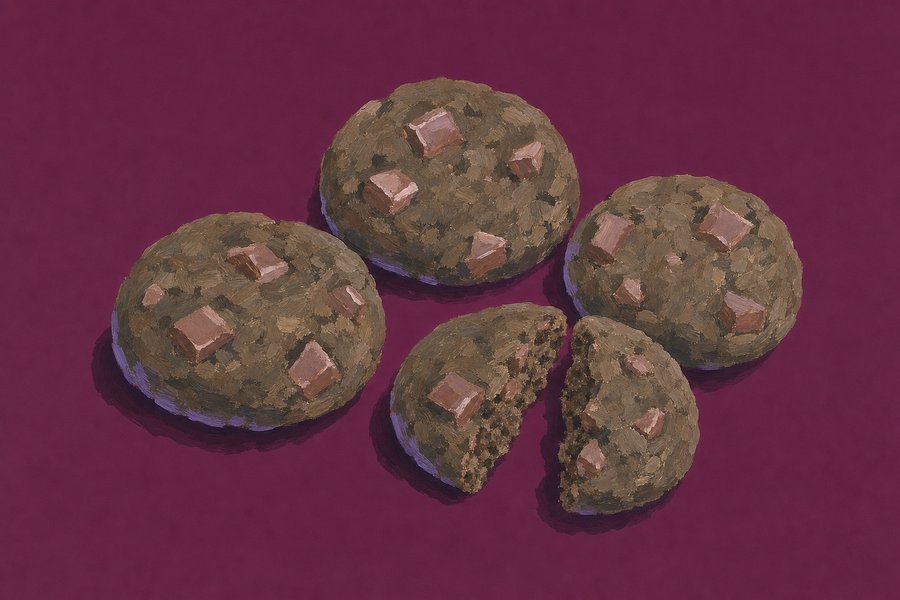
Which makes it the wrong place to experiment blind and a good place to notice a difference. Chocolate in the dough, as this page’s original subject had, complicates the reading further: cocoa solids absorb liquid too, so two variables move at once.
The rye entries and the ingredient glossary sit with the Nordic section, the wider biscuit terminology is at biscuits and cookies, and the terms are in the glossary.
Questions about rye in biscuits
What does rye flour do in a sweet biscuit?
Not established here. Two explanations circulate, low gluten-forming protein and high pentosans, and neither was verified against a source good enough to print, so neither is stated as fact on this page.
Can rye replace wheat flour by weight?
Not reliably in any application on this site. In bread the direction is documented: substituting straight rye for rågsikt gives a much denser, drier loaf. In a biscuit the size of the effect is not something this page can predict.
What is rågsikt?
Sifted rye blended with wheat, and it is what a kavring is actually built on rather than wholemeal rye. Rye in a Nordic recipe usually means a blend rather than the pure grain the English word suggests.
Why is shortbread a bad dough to substitute rye into blind?
Because it has no egg, no leavening and no liquid binder, so there is nothing in the formula to mask a flour with different absorption. That also makes it a good dough for noticing a difference, just not for guessing at one.