Three conditions, and what each one does
Pectin is the structure. It is a polysaccharide in the cell walls, most concentrated in skins, cores and pips, which is why a jelly bag of apple cores is worth more than the flesh it came from. Acid does not thicken anything by itself; it lowers the pH far enough that the pectin chains stop repelling each other and can bond. Sugar competes for the water, taking it out of the way so those bonds can form and hold.
The practical consequence is that the three are not interchangeable. Boiling a low-pectin fruit longer in more sugar concentrates the syrup without building a gel, and the result is thick rather than set, and it will pour cold. A fruit with plenty of pectin but too little acid stays liquid no matter how long it cooks, and a spoonful of lemon juice fixes it in a minute. Knowing which case you are in is the whole diagnosis, and it is why the fruit register keeps acid and pectin in separate columns instead of scoring them together.
Set groups: how much help a fruit needs
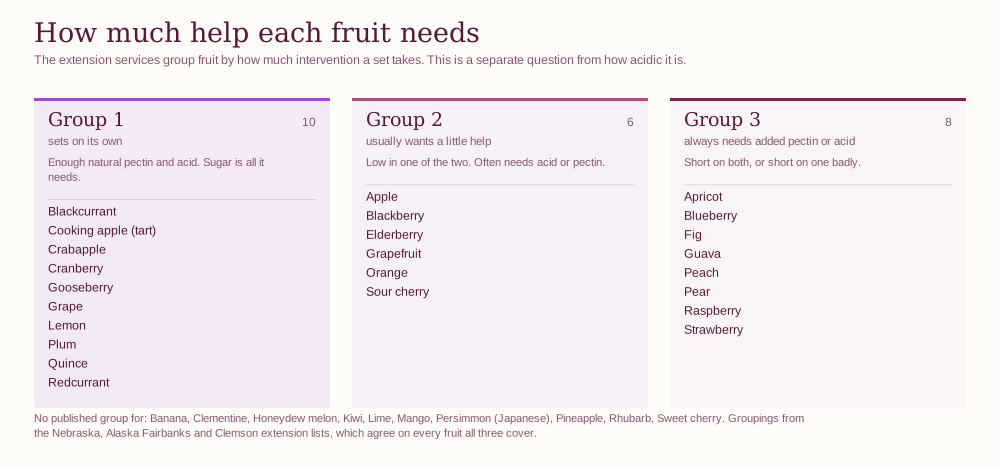
The extension services classify fruit by how much intervention a set requires. Group 1 manages on its own sugar and its own acid. Group 2 usually wants a little help. Group 3 needs added pectin, added acid, or a partner fruit that brings one of them.
- Group 1, sets unaided: Cooking apple (tart), Blackcurrant, Crabapple, Cranberry, Gooseberry, Grape, Lemon, Plum, Quince and Redcurrant.
- Group 2, usually needs a little help: Apple, Blackberry, Sour cherry, Elderberry, Grapefruit and Orange.
- Group 3, needs added pectin or acid: Apricot, Blueberry, Fig, Guava, Peach, Pear, Raspberry and Strawberry.
10 of the thirty-four fruits carry no published group at all. Those are not group 3 by default; they are unclassified, and the honest way to treat one is to test it on a cold plate rather than assume.
The most useful trick in the list is partnering. Any group 1 fruit added to a group 3 one brings its pectin along: quince or tart apple with a soft stone fruit, redcurrant with strawberry, gooseberry with elderflower. It does the same job as a sachet of pectin and it tastes of something.
What none of this settles is quantities, and that is the question most people arrive with. Work out a batch takes a fruit and a weight and reports what sugar and water the fruit itself brings, how much water has to leave the pan, and what share of the finished jar is fruit, out of the same measured figures, with the places the sources run out left visible.


The other reason acidity matters
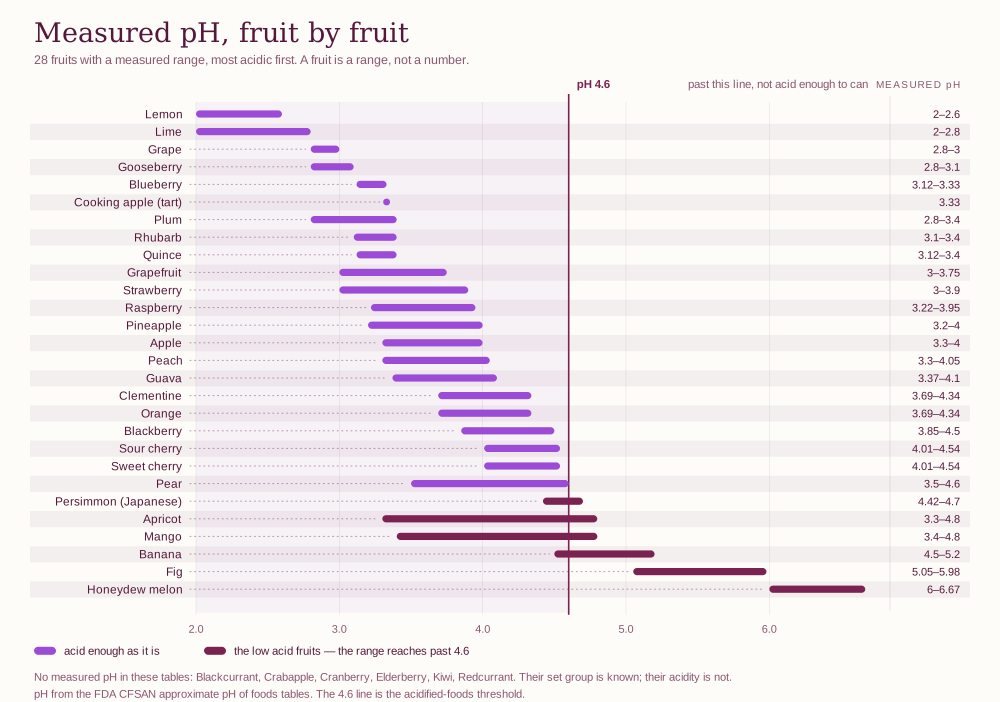
Setting and safety are separate questions with separate thresholds, and only one of them is about texture. The pH 4.6 line decides whether a jar can be processed in a boiling-water bath at all. Below it, the acidity itself is doing preserving work. Above it, it is not, and the jar needs either added acid or a pressure canner.
On the measured ranges in the register, the fruits whose range crosses that line are Apricot, Banana, Fig, Mango, Honeydew melon and Persimmon (Japanese). None of them is obvious from taste, since a ripe fig reads as sweet rather than flat, and sweetness is not the same axis as acidity. Where a range straddles 4.6, treat the fruit as the less acidic case.
Under-ripe fruit is not a compromise
Pectin is highest in fruit that is slightly under its eating ripeness and falls as the fruit softens, because ripening breaks the pectin down. That softening is the same process. A jam made entirely from perfectly ripe fruit tastes best and sets worst. The usual answer is to use a mixture, with a proportion of firmer, less ripe fruit for structure and the ripest for flavour, rather than choosing one and accepting its weakness.
The cold-plate test beats any chart
Charts predict; a cold plate measures. Keep two saucers in the freezer before you start. Take the pan off the heat, put a small spoonful on a chilled saucer, wait a minute, then push it with a fingertip. If the surface wrinkles and the trail holds open, it is set. If it floods back, it is not, and it goes back on the heat for two more minutes before you test again.
Take the pan off the heat while you test. A jam that boils on unattended for the two minutes you spend looking at the saucer is a jam that goes past its set, and an over-boiled preserve cannot be rescued the way an under-set one can. An under-set jar can be re-boiled with added pectin, while a caramelised one is a different product.
Work out a batch
The register says what a fruit is. This works out what a quantity of it becomes. Pick a fruit and a weight and it reports what sugar and water the fruit itself brings, how much water has to leave the pan before the mixture is a preserve rather than a syrup, what share of the finished jar is fruit, and whether that share clears the minimum the EU definition sets for the word jam. Nothing is rounded up into advice: the sugar ratio is yours to choose, and where a fruit has no measured figure the sheet computes nothing and names the value that is missing.
1,000 g of strawberry, with equal weights of sugar
- Sugars in the fruit
- measured 49 g
- Water in the fruit
- measured 910 g
- Sugar you add
- your ratio 1,000 g
- In the pan
- 2,000 g, of which 1,049 g is sugar, at 52.4%
- Water to drive off
- 252 g
- Finishes at
- 1,748 g, about 5.1 jars of 340 g
- Fruit in the finished jar
- 572 g per 1000 g
At 572 g of fruit per 1000 g finished, this clears both EU minimums: 450 g for jam and 500 g for extra jam, on fruit content alone. It would take sugar at more than 1.28 times the fruit weight to fall below the jam minimum, and more than 1.15 times to fall below extra jam. Of the two conditions the definition sets, fruit content is the easy one at home; the 60% concentration is the one that takes the boiling.
What it needs Add pectin. Acid enough, pectin short. It needs added pectin or a high-pectin partner; boiling it down further concentrates sugar without creating the network that sets it.
Canning as it is Its whole measured range, 3–3.9, sits below 4.6.
What the sheet is doing, and what it will not do
The sugar and water figures are the register's own, from USDA FoodData Central, multiplied by the weight you gave. Everything after that is one calculation against one published definition: Council Directive 2001/113/EC requires a jam to reach 60% soluble dry matter, measured on a refractometer at 20 °C, so the finished weight is the sugar in the pan divided by 0.60, and the difference between that and the pan weight is water that has to go. The same directive, as amended in 2024, sets the minimum fruit at 450 g per 1000 g of finished product for jam and 500 g for extra jam, which is what the fruit-share line is measured against.
Two honest qualifications on that. The arithmetic treats soluble dry matter as the sugars alone, and it is not only sugars. Acids, pectin and other solubles register on a refractometer too, so the finished weight given is the earliest point a batch could qualify, not the exact one. And a legal name carries conditions beyond fruit content, so the line above is about that one condition and no others. What actually settles a set is neither figure but the cold plate; the temperature usually quoted alongside it is 220 °F, or 8 °F above the boiling point of water where you are, which is about 104.4 °C at sea level.
The sheet gives no acid dose, and that is deliberate. The only quantified figure in the extension literature consulted is 1 tablespoon of lemon juice, or 1/8 teaspoon of citric acid, per cup of fruit juice. That is a jelly measure, by volume, for juice rather than fruit. Nothing consulted gave a dose per weight of fruit for a jam. Converting a volume ratio into a mass one and presenting the result as guidance is exactly the kind of invented number this register exists to replace, so the figure is quoted here in its own unit and the gap is left visible.
Six of the 34 fruits, namely cooking apple (tart), blackcurrant, crabapple, elderberry, gooseberry and quince, have no sugar or water figure in the source at all, which for quince and gooseberry is a real gap, since both are preserving fruits of the first rank. Choose one and the sheet reports the missing value instead of a number. The rest of the answer, what the fruit needs and which side of the 4.6 line it falls, does not depend on those two figures and is still given.
By hand, for any fruit in the register: multiply its sugars per 100 g by your weight in hundreds of grams, add the sugar you intend to add, divide the total by 0.60, and that is what you will be left with.
Questions about setting
My jam did not set. What now?
Work out which condition was missing before adding anything. If the fruit is high in pectin but low in acid, lemon juice will set it. If the pectin is low, more acid and more boiling will not: it needs added pectin or a high-pectin partner fruit. Re-boiling with the missing element usually works; re-boiling without it just concentrates the syrup.
Does adding more sugar make a jam set?
No. Sugar is one of the three conditions and cannot substitute for a missing one. Extra sugar in a low-pectin fruit gives you a thick syrup rather than a gel, and it pushes the finished preserve towards toffee flavours.
Which fruits set without added pectin?
The set-group 1 fruits: quince, crabapple, cranberry, redcurrant, blackcurrant, gooseberry, grape, plum, tart cooking apples and the citrus fruits. Quince is the extreme case, which is why quince paste sets firm enough to slice.
Where does pectin sit in the fruit?
Mostly in the skins, cores and pips rather than the flesh, and it is highest in slightly under-ripe fruit. That is why a muslin bag of apple cores and citrus pips suspended in the pan is a standard way to reinforce a weak-setting jam.
Is a set the same thing as being safe to can?
No, and confusing them is the common mistake. A set is about pectin, acid and sugar together. Water-bath safety is about acidity alone, against the pH 4.6 line. A jam can be perfectly set and still be a fruit that needs a pressure canner.