What pectin is
Pectin is a polysaccharide in the cell walls of fruit. In the fruit it works as cement between cells; in a pan it does something else, because heat frees the chains into the surrounding liquid where they can bond to one another and hold that liquid in a network. That network is the set. A jam is not thick syrup. It is a liquid trapped inside a pectin structure, which is why a set jam holds a shape when a reduced syrup only pours slowly.
Two conditions have to be met before the chains will bond, and both are outside the pectin itself. Acid neutralises enough of the charge the chains carry to stop them repelling each other, and sugar competes for the water that would otherwise keep them apart. That is why this site keeps three separate conditions rather than one score: a fruit rich in pectin and short of acid does not set, and neither does the reverse.

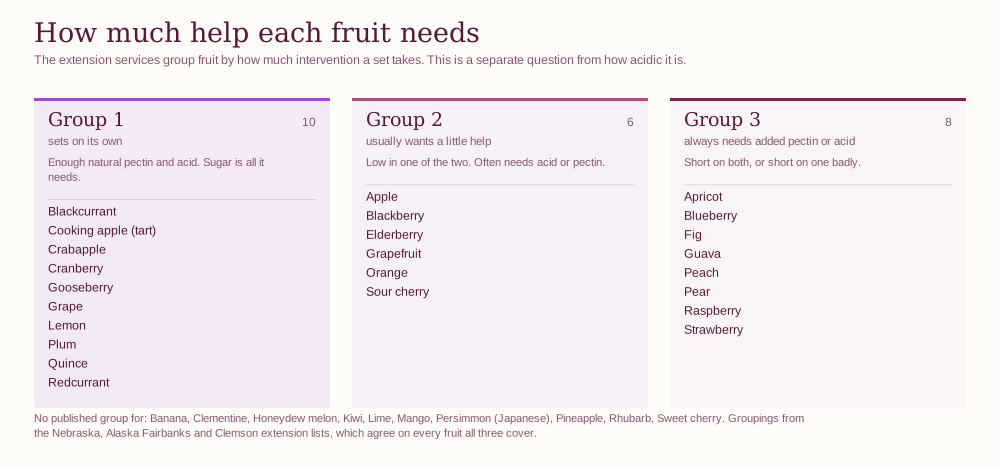
Which fruits have enough
Of the 34 fruits in the register, 13 are classified high in pectin: cooking apple (tart), blackcurrant, crabapple, cranberry, gooseberry, grape, grapefruit, lemon, lime, orange, plum, quince, redcurrant. Those are the fruits that gel on their own pectin when there is acid and sugar in the pan. 7 are classified low: apricot, blueberry, sweet cherry, peach, pineapple, rhubarb, strawberry. Those need pectin from somewhere else.
The remaining 14 carry no published classification at all, and the register says not established rather than filling the gap. That is worth knowing before trusting any table that gives all thirty-four a value: the most widely circulated version of this table lists guava as very low in pectin, which is not a measurement of anything, and guava's real problem is that it is low in acid.
The per-fruit figures, with the pH range and the sugars beside them, are in the fruit register. Every value there names its source, and the sources themselves are listed on the sources page.
The three ways to get pectin into a pan
From the fruit. The cheapest route, and the only one that needs no decision: choose a fruit that has it. The set-group 1 fruits (cooking apple (tart), blackcurrant, crabapple, cranberry, gooseberry, grape and the citrus) are on the extension listings precisely because they gel unaided.
From a partner fruit. A proportion of a high-pectin fruit changes the behaviour of the whole pan. Tart cooking apple is the traditional northern partner because it is nearly invisible in the finished flavour; redcurrant and gooseberry bring pectin and sharpness together, which suits a fruit short of both and not a fruit short of pectin alone.
Added, as a product. Powdered and liquid pectin, and the preserving sugars that have pectin and acid already blended in. These are not interchangeable by volume: strengths differ between products, and the dose that matters is the one on that packet rather than one carried over from another recipe.
Pectin is not the only setting agent
A preserve sets on pectin. Most other things in a kitchen that set do not, and the confusion between them is the reason a technique that works in one place fails in another. A pastry cream sets on cooked starch, a curd on egg, a ganache on cooled fat, a panna cotta on gelatin. None of those is improved by acid, and two of them are damaged by it.
The five mechanisms are set out side by side in setting agents, which is the page to read before substituting one for another.
Questions about pectin
What is pectin?
A polysaccharide in the cell walls of fruit. Heated in a pan it is released into the liquid, where the chains bond into a network that holds the liquid in place. That network is what a set jam is.
Which fruits are high in pectin?
In this register, 13 of 34 are classified high: cooking apple (tart), blackcurrant, crabapple, cranberry, gooseberry, grape, grapefruit, lemon, lime, orange, plum, quince, redcurrant. The classification comes from the Nebraska, Alaska Fairbanks and Clemson extension listings.
Do I need pectin for jam?
Only if the fruit has not got enough of its own. A high-pectin fruit sets on sugar and its own acid; a low-pectin fruit needs added pectin or a high-pectin partner, and no amount of extra boiling substitutes for it.
Does adding lemon juice add pectin?
No. Lemon adds acid, which is a different condition. Acid lets pectin bond, so it fixes a fruit that has pectin and not enough acid. It does nothing for a fruit that is acidic already and short of pectin, which is the usual case with rhubarb.
Is powdered pectin the same as liquid pectin?
Not in strength or in how they are used, and neither is interchangeable with preserving sugar, which already contains pectin and acid. Use the dose printed on the product in hand rather than one from another recipe.