What the measurements say
Rhubarb measures pH 3.10 to 3.40, which puts it among the most acidic entries in the register, more acidic than a plum and well inside the range where a pectin gel forms readily. Its sugars are 1.1 g per 100 g, the lowest of any fruit here. And its pectin class is low.
Those three figures together explain everything difficult about a rhubarb jam. The acid is already there, so adding lemon changes nothing that matters. The sugar in the fruit is negligible, so essentially all the sugar in the finished preserve is sugar you added. And the pectin is not sufficient to build a gel, which is the part no amount of boiling corrects.
This is why rhubarb is the example worth remembering when reading any table that gives a fruit a single “pectin level” or a single “setting” score. Rhubarb would score well on acid and badly on pectin, and a combined figure would put it in the middle, which is exactly the wrong answer: it needs one specific intervention and not the other.
Why more lemon will not help
Acid does one job in a preserve. Pectin chains carry a charge that makes them repel one another, and lowering the pH neutralises enough of that charge for the chains to bond into a network. At rhubarb's measured pH that condition is already satisfied. Adding more acid past the point where the pectin can bond does not make it bond harder; it only makes the preserve sharper.
The failure mode people report follows from that. A rhubarb jam boiled long in the hope of a set does concentrate, as the fruit collapses to a purée and the syrup thickens, but it thickens rather than sets, and it will still pour when cold. Pushed further it caramelises, because with so little sugar of its own the pan is carrying mostly added sucrose.
What actually corrects it
Two interventions work, and they are the same two that work for any low-pectin fruit.
Added pectin. The direct answer, and the one commercial preserving sugars provide. It is worth reading the packet rather than the recipe here, because pectin sugars vary in strength and a fruit this low needs the dose the manufacturer specifies rather than a generic one.
A partner fruit that brings pectin. The set-group 1 fruits gel unaided, and any of them in proportion changes the behaviour of the pan: Cooking apple (tart), Blackcurrant, Crabapple, Cranberry, Gooseberry, Grape and the citrus fruits. Tart cooking apple is the traditional partner in northern kitchens and is nearly invisible in the finished flavour; redcurrant and gooseberry both bring pectin and their own sharpness, which suits rhubarb less well since sharpness is not what it lacks.
There is a third option that is not a correction but a decision: accept the texture. A loose rhubarb preserve, somewhere between a compote and a jam, is a legitimate product rather than a failed one, and it is what a great deal of home-made rhubarb actually is. What matters is choosing it rather than arriving at it after an hour of boiling.
Rhubarb is a vegetable, and one part of it is not food
Two facts worth stating on any rhubarb page. It is botanically a vegetable, since the stalks are leaf stalks, which is why it appears in a fruit register at all only by culinary convention. And the leaves are not edible: they contain oxalic acid at levels that make them unsafe, and only the stalks are used. Trim and discard the leaves rather than composting them into anything that will be eaten.
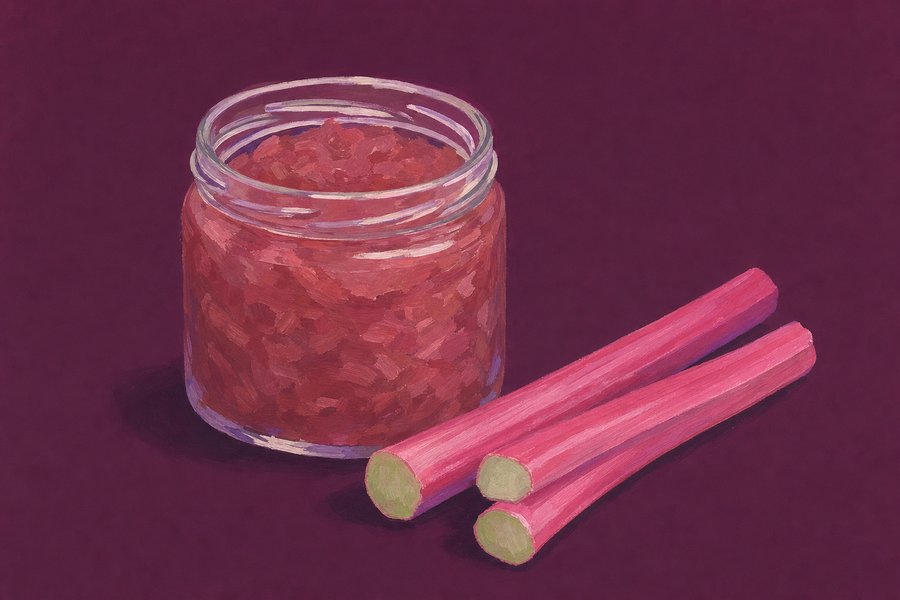
Colour is the other thing that surprises people. The deep pink of forced early rhubarb is a property of the variety and the growing, not of ripeness, and a green-stalked maincrop rhubarb makes a preserve that tastes the same and looks brown. Cooks who want a pink jam either choose forced stalks or accept the colour; nothing added in the pan will produce it.
The full per-fruit figures are in the fruit register, and the mechanism behind all of this is set out in the preserves section.
Questions about rhubarb preserves
Why will my rhubarb jam not set?
Because rhubarb’s pectin is low, and pectin is the thing that builds the gel. Its acid is already more than sufficient at pH 3.10 to 3.40, so the usual fix of adding lemon does nothing. It needs added pectin or a high-pectin partner fruit.
Does rhubarb need lemon juice?
Not for the set. Rhubarb is among the most acidic fruits measured, so the acid condition is already met. Lemon will sharpen the flavour and will not improve the texture.
What is the best partner fruit for rhubarb?
Tart cooking apple, which is set-group 1 and nearly invisible in the finished flavour. Redcurrant and gooseberry also bring pectin but add sharpness, which rhubarb does not need.
Are rhubarb leaves poisonous?
They are not edible: they carry oxalic acid at levels that make them unsafe, which is why only the stalks are used. Trim the leaves off and discard them, and keep them out of anything else that will be eaten.
Why is my rhubarb jam brown rather than pink?
The pink is a property of the variety and of forcing, not of ripeness. Green-stalked maincrop rhubarb tastes the same and cooks to a brown preserve. Nothing added in the pan will produce the colour.