It is a vegetable, and the part used is a stalk
Rhubarb is botanically a vegetable, and what is eaten is the leaf stalk, the petiole, rather than a fruit at all. It appears in a fruit register only by culinary convention, in the same way that a tomato appears among vegetables. That is not pedantry: it explains the sourness, the fibrousness and the near-total absence of sugar, all of which are stalk properties.
The leaves are not edible. They carry oxalic acid at levels that make them unsafe to eat, and only the stalks are used. Trim them off and discard them rather than putting them anywhere they might be eaten later. This is the one fact on the page that matters more than any cooking consideration.
The three numbers that decide how it behaves
Rhubarb measures 93.61% water, the highest of the thirty-four fruits in the register, with only 1.1 g of sugars per 100 g, the lowest of any of them, and a pH of 3.10 to 3.40, which is among the most acidic. Its pectin class is low.
Each of those has a direct kitchen consequence. Being almost entirely water, rhubarb collapses to liquid rather than to purée and floods anything it is baked inside. Having essentially no sugar of its own, every gram of sweetness in a finished dish is sweetness that was added, which is why rhubarb recipes look startlingly sugar-heavy on paper. Being very acidic, it needs no lemon. And being low in pectin, it will not set, which is the subject of the rhubarb jam page.
The water figure is the one people underestimate. At 93.61% it is wetter than strawberry and considerably wetter than apple, so a tart filled with raw rhubarb releases more liquid than most fruit fillings and needs either a pre-cook, a thickener, or a pastry case built to take it. That is covered at rhubarb and custard squares.
Forcing, colour and season
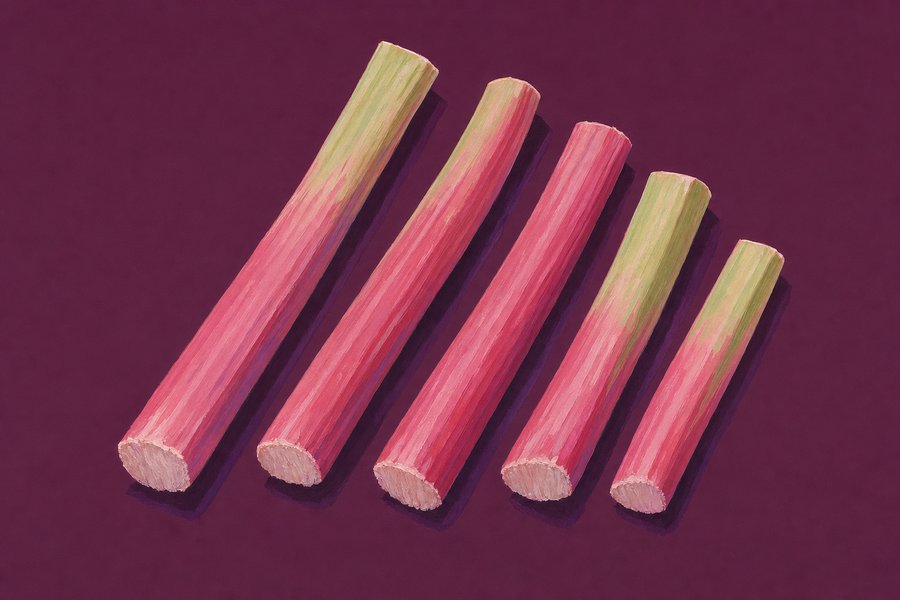
Early rhubarb is forced: grown in the dark so the stalks lengthen looking for light, which produces the slender, deep pink, tender stalks sold at the start of the season. Maincrop rhubarb grown in daylight is greener, thicker and more fibrous.
The colour is therefore a property of how it was grown, not of ripeness, and it does not develop with cooking. A green-stalked maincrop rhubarb makes a preserve or a compote that tastes the same as a pink one and looks brown. Cooks who want a pink result choose forced stalks; nothing added to the pan produces the colour, and the various tricks suggested for it are working on the liquid rather than on the fruit.
Season is short and the plant is perennial, which is why rhubarb behaves unlike most fruit in a kitchen calendar: it arrives before anything else does, in late winter under forcing pots and through spring outdoors, and stops being worth picking by midsummer when the stalks turn woody. Late-season stalks are not unsafe, only tougher and more fibrous.
Thickness matters more than colour for cooking. Thick maincrop stalks are more fibrous and benefit from being peeled or sliced thinner; forced stalks need neither. Neither is better, and the difference is worth knowing only so that a recipe written for one is adjusted for the other.
Why it is treated as a fruit
Because of how it is used rather than what it is. Rhubarb is cooked with sugar and served as a dessert almost everywhere it is grown, and culinary categories follow use. In the United States there is even a legal precedent to that effect from the 1940s, which is the kind of fact that gets repeated because it is satisfying rather than because it changes anything in a kitchen.
The practical upshot is that rhubarb sits in the fruit register alongside things it has little in common with, and its row there is one of the most useful in the table precisely because it breaks the pattern: high acid, low pectin, almost no sugar, almost all water. The full set of figures is in the register.
Questions about rhubarb
Is rhubarb a fruit or a vegetable?
Botanically a vegetable, since the part eaten is a leaf stalk. It is treated as a fruit because of how it is used, cooked with sugar and served as a dessert.
Are rhubarb leaves poisonous?
They are not edible. The leaves carry oxalic acid at levels that make them unsafe, and only the stalks are used. Trim them off and discard them.
Why do rhubarb recipes use so much sugar?
Because rhubarb brings almost none of its own, at 1.1 g per 100 g, the lowest in the register. All the sweetness in the finished dish is sweetness that was added, so the quantities look higher than for a fruit that arrives sweet.
Why is my rhubarb green, and does it matter?
It is maincrop rather than forced. Colour comes from how it was grown, not from ripeness: forcing in the dark gives slender pink stalks. Green stalks taste the same and cook browner; they are also thicker and more fibrous.
Why does rhubarb make everything so wet?
Because it is 93.6% water, the highest of any fruit in the register. It collapses to liquid rather than to purée, so anything baked with raw rhubarb needs a pre-cook, a thickener or a case built to take the liquid.