A recipe tells you what to do once. A ratio tells you what you are making, which is the thing that transfers. Nearly all of the confusion in French pastry vocabulary comes from names that describe an addition rather than a substance: five of the six creams below are the same cooked custard with one further ingredient folded in, and the name changes with the addition.
The cream family: one base, five additions
Crème pâtissière is milk, egg, sugar and starch, cooked until the starch thickens and then cooked a little longer so it does not taste of flour. Everything else in this table starts from it. The exception is crème anglaise, which has no starch at all and therefore can never be piped, because it is a sauce, and the reason it appears here is that it is the one most often confused with the others.

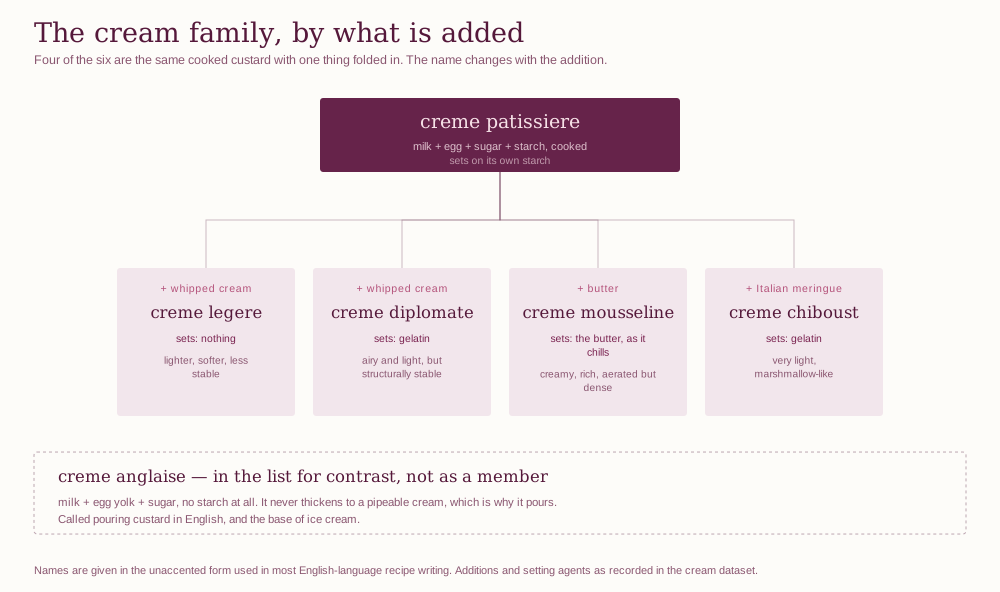
| Cream | Also called | Built on | Addition | What sets it | Classic use |
|---|---|---|---|---|---|
| Crème pâtissière | pastry cream, crème pat, confectioner's custard | milk + egg + sugar + starch, cooked | — | starch (cooked out) | Éclairs, tarts, mille-feuille, choux |
| Crème légère | light pastry cream | crème pâtissière | whipped cream | none | Fruit tarts, quick fillings |
| Crème diplomate | diplomat cream | crème pâtissière | whipped cream | GELATIN | Fraisier, fruit entremets |
| Crème mousseline | mousseline cream, German buttercream | crème pâtissière | BUTTER (beurre pommade) | none - the butter sets on chilling | Tarte tropézienne, Paris-Brest |
| Crème chiboust | Chiboust cream | crème pâtissière | ITALIAN MERINGUE | GELATIN | Saint-Honoré |
| Crème anglaise | pouring custard, crème anglaise | milk + egg yolk + sugar, NO starch | — | none | Sauce; base for ice cream and bavaroise |
“Crème pat” is the ordinary British shorthand for crème pâtissière, and “confectioner's custard” is the older name for the same thing.
Which one do you actually want
- You need a thick pipeable filling that holds its shape: crème pâtissière.
- You need pastry cream lightened with whipped cream, without gelatin: crème légère.
- You need pastry cream lightened with whipped cream, with gelatin: crème diplomate.
- You need pastry cream lightened with butter (beurre pommade), without gelatin: crème mousseline.
- You need pastry cream lightened with italian meringue, with gelatin: crème chiboust.
- You need a pouring sauce: crème anglaise.
Two of those choices are frequently swapped by mistake. Crème légère and crème diplomate are both pastry cream lightened with whipped cream; the difference is that diplomate carries gelatin and therefore holds a shape overnight, while légère softens. If a fruit tart looked right in the evening and slumped by morning, that is the distinction that was missed.
Why a pastry cream splits, and what to do
Two failures account for nearly all of them. The first is undercooking: starch needs to come to a full boil and be held there briefly, or it neither reaches full thickening power nor loses the raw taste, and the cream slackens as it cools. The second is scrambling the egg, which happens when hot milk meets cold yolk too quickly. Pouring a little of the hot milk into the yolk mixture first, whisking, and only then returning everything to the pan keeps the egg below the temperature at which it sets in lumps.
A cream that has thickened correctly and then weeps in the fridge has usually been over-whisked after cooking, which tears the starch network. A cream that will not thicken at all, with the starch measured correctly, has normally been made with an acidic addition, whether lemon or a fruit purée, added before the starch had set, because acid degrades starch as it cooks. Add acid afterwards.
Tart doughs: sucrée, sablée, brisée
The three doughs differ in two variables, and the second matters more than the first. Sugar and butter proportions set the flavour and the crumb; the method decides whether the dough can hold a wet filling. Sablage means rubbing the fat into the flour first, so every particle of flour is coated and gluten cannot develop. That is what makes a sablée sandy and also what makes it fragile.

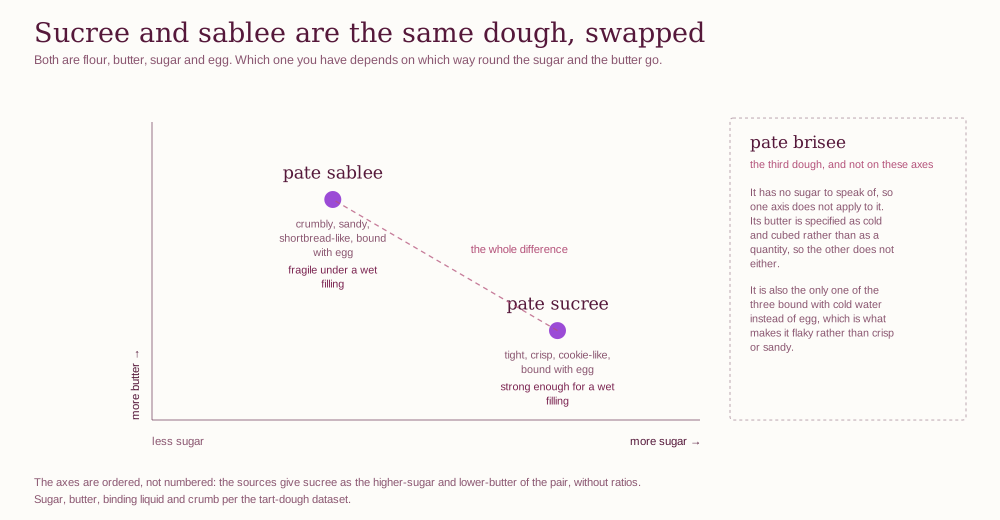
| Dough | Sugar | Butter | Liquid | Crumb | Holds a wet filling |
|---|---|---|---|---|---|
| Pâte brisée | none or minimal | cold, cubed | cold water | Flaky, layered | Moderate |
| Pâte sucrée | HIGHER than sablee | LOWER than sablee | egg | Tight, crisp, cookie-like | YES - strong enough to hold a liquid filling without leaking |
| Pâte sablée | LOWER than sucree | HIGHER than sucree | egg | Crumbly, sandy, shortbread-like | Weaker - fragile |
Pâte sucrée carries more sugar and less butter than sablée, and is the one strong enough to take a liquid filling without leaking. Pâte brisée is barely sweetened and is the flaky one, because its butter goes in cold and in pieces rather than creamed.
Blind baking: the numbers
Baking a pastry case before (or without) its filling, so the base sets and crisps instead of going soggy under a wet filling. It is called blind because it bakes empty.
- Shortcrust at 190 °C for 15-20 minutes for a case that will bake again with its filling, 25-30 minutes for one taking a no-bake filling.
- Puff at 200 °C for 20-25 minutes partially, 30-35 fully.
- Parchment paper or aluminium foil. Line the case after chilling it, then add weights.
- Ceramic pie weights, dried beans, rice, lentils, sugar or dried pasta.
- Prick the base all over with a fork before baking.
One safety point, because it is asked often and the answer is not obvious: standard cling film is not oven-safe. Home ovens run roughly 163 to 232 °C and most cling film softens well below that, so it can melt, warp or transfer chemicals into food. Use parchment or foil. Products sold specifically as oven-safe cling film exist, but only within the limits printed on their own packaging.
Dried pulses, rice and sugar all work as weights and are reusable many times over, which is the honest answer to whether you can blind bake with rice. They stop being any good as food afterwards, so keep a jar for the purpose.
Where a technique depends on the fruit rather than the pastry, on whether a filling will set or weep into the base, the numbers are in the fruit register.
Questions about technique
What is crème pâtissière, in one sentence?
Milk, egg, sugar and starch cooked together until the starch thickens and then held a little longer so the raw-flour taste cooks out. It is thick enough to pipe and to hold its shape, which is what separates it from a pouring custard.
What is the difference between mousseline cream and pastry cream?
Crème mousseline is pastry cream, with softened butter beaten into it. Nothing else sets it; the butter firms on chilling. It is richer and denser than a cream lightened with whipped cream, and it is the filling in a tarte tropézienne and a Paris-Brest.
Pâte sucrée or pâte sablée for a lemon tart?
Sucrée. It has the higher sugar and the lower butter of the two, and it is made by creaming rather than by sablage, which gives it enough strength to hold a liquid filling. A sablée case is more likely to leak.
What does blind bake mean?
Baking the pastry case before, or entirely without, its filling, so the base sets and crisps instead of going soggy underneath something wet. Line the chilled case with parchment or foil, weight it, and prick the base first so steam can escape.
Can I use cling film to line a case for blind baking?
No. Standard cling film softens below normal oven temperatures and can melt or transfer chemicals into the food. Parchment or foil only, unless a product is sold explicitly as oven-safe and you stay inside its stated limits.
Further reading on baking as a subject and its history: Britannica.