What does blind bake mean?
Anyone asking how to blind bake pastry usually wants two numbers and one reassurance, so those come first, below. But the term itself is worth settling: what does blind bake mean is simply baking a pastry case before, or entirely without, its filling, so the base sets and crisps instead of going soggy under something wet. It is called blind because it bakes empty.
That is the whole of it. What does blind bake mean in practice is a decision about how far to take it: partially, for a case that will go back in the oven with its filling, or fully, for one that takes a filling which is never baked at all. The two have different durations and it is the commonest thing to get wrong.
Temperature and how long
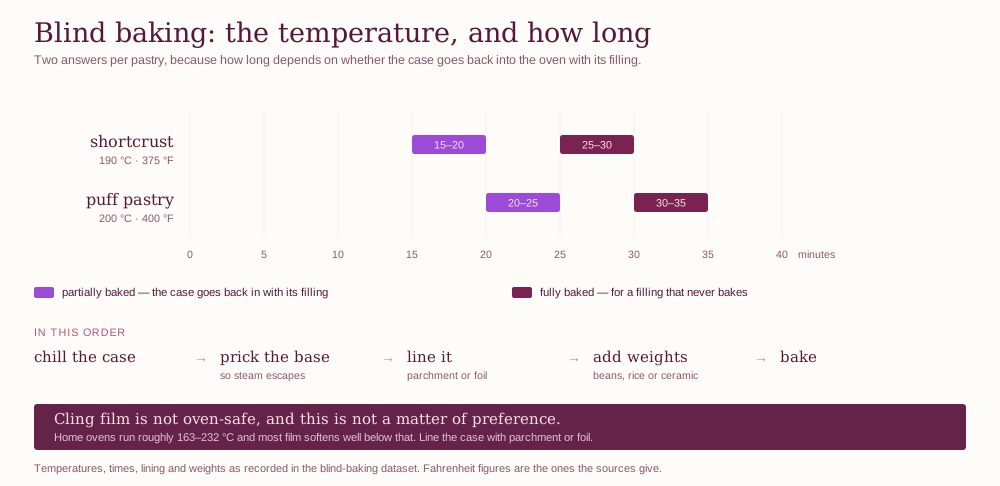
The temperature is the shorter half of the answer. Shortcrust blind bakes at 190 °C, puff pastry at 200 °C. The temperature does not change between a partial and a full bake; only the time does.
- Shortcrust, partially baked: 15-20 minutes, for a case that will bake again with its filling.
- Shortcrust, fully baked: 25-30 minutes, for a case taking a no-bake filling.
- Puff, partially baked: 20-25 minutes.
- Puff, fully baked: 30-35 minutes.
How long is always the question that gets asked and it is the one most dependent on the oven. These are the published figures; how long a given case actually needs is judged by colour at the rim and dryness at the centre. A fully blind-baked shortcrust case should be an even biscuit colour across the base, not pale in the middle.

How to blind bake pastry: the sequence that matters
How to blind bake pastry, reduced to the order of operations, because the order is where it fails rather than the numbers.
- Chill the case first. Parchment paper or aluminium foil.
- Dock the base. Prick the base all over with a fork before baking.
- Weight it. Ceramic pie weights, dried beans, rice, lentils, sugar or dried pasta.
Docking is the step most often skipped and it is the reason a base domes unevenly: pricking it lets steam escape instead of lifting the pastry off the tin. Chilling before lining matters because a warm case slumps down the sides as the fat softens, and no quantity of weights fixes a case that has already sagged.
Blind baking with rice, and other weights
Blind baking with rice works, and so does blind baking with dried beans, lentils, sugar or dried pasta. Ceramic pie weights are sold for the job and are marginally more convenient because they conduct a little heat, but they are not better in any way that shows in the pastry. Dried pulses, rice and sugar are all reusable many times over.
The one caveat on blind baking with rice is that the rice stops being food. It dries out thoroughly and will not cook properly afterwards, so keep a labelled jar for the purpose rather than returning it to the cupboard.
Can cling film go in the oven?
No. Asked as plainly as it is usually typed, can cling film go in the oven, standard cling film is not oven-safe. Home ovens run at roughly 163 to 232 °C and most cling film softens well below that, so it can melt, warp or transfer chemicals into the food. Line the case with parchment or foil instead.
The reason anyone asks can cling film go in the oven is that it is genuinely used in professional kitchens for low-temperature work, and that products explicitly sold as oven-safe cling film do exist. Those are usable only within the limits printed on their own packaging, and the ordinary roll in a domestic drawer is not one of them. For blind baking, where the case sits at nearly 200 °C for twenty minutes or more, it is not a close call.
Which pastry, and why the choice affects the bake
Not every pastry needs the same treatment, because not every pastry is at equal risk from a wet filling. A dough strong enough to hold liquid without leaking can take a shorter partial bake; a fragile one needs a full one and a sealed base. That is a property of how the dough was made rather than of what it contains, and it is set out in the comparison of the three tart doughs.
A last note on sealing. Brushing a fully blind-baked case with beaten egg white or a little melted chocolate and returning it to the oven for a minute or two glazes the surface and gives a wet filling one more barrier. It is not part of blind baking proper, but it addresses the same problem the technique exists to solve.
Questions about blind baking
What does blind bake mean?
Baking a pastry case before, or entirely without, its filling, so the base sets and crisps rather than going soggy under something wet. The name comes from the case baking empty.
How long do I blind bake, and at what temperature?
Shortcrust at 190 °C for 15-20 minutes partially, 25-30 minutes fully. Puff at 200 °C for 20-25 minutes partially, 30-35 fully. The temperature is the same for both stages; only the time changes.
Can I blind bake with rice?
Yes, and with dried beans, lentils, sugar or dried pasta. All are reusable many times. The rice will not cook properly afterwards, so keep a separate labelled jar for it.
Can cling film go in the oven?
No. Home ovens run around 163–232 °C and most cling film softens below that, so it can melt, warp or transfer chemicals into food. Use parchment or foil. Products sold specifically as oven-safe exist but only within their own printed limits.
Why does my base dome up in the middle?
The base was not docked. Pricking it all over with a fork before baking lets steam escape instead of lifting the pastry off the tin. Weights alone will not prevent it.
Do I need to blind bake at all?
Only where a filling would wet the base before the pastry sets, so custards, quiches and anything unbaked. A dry or short-baked filling in a strong dough does not need it.