The answer, and its name
A custard made without cornflour or any other starch is crème anglaise: milk + egg yolk + sugar, NO starch. It thickens because egg yolk protein coagulates as it warms, and that is the only mechanism in it. The cream dataset records its setting agent as none beyond that, and its texture as pourable, never pipeable.
Which is the part worth knowing before starting: the contrast case, and the most common confusion: no starch, so it never thickens beyond coating consistency and it curdles if boiled. It is not a thin version of the thick custard in a tart. It is a sauce, and the two are made for different jobs.

What the starch was doing
Two things, and neither is thickening in the way it looks. Starch granules swell and gelatinise at heat, which builds a body the egg alone cannot reach, and they also protect the egg. A starch-thickened custard can be brought to a boil, and has to be, for the starch to gelatinise and for the flour taste to cook out. A starchless one cannot: taken past roughly the point where it coats a spoon, the yolk protein tightens into curds and the sauce is finished, permanently.
That is why every recipe for one is anxious about temperature and every recipe for the other is not. It is also why substituting is not free in either direction: adding starch to a crème anglaise makes something else entirely, and removing it from a crème pâtissière produces a filling that will never hold a shape in a tart case, however long it is stirred.
If you have no cornflour and want a thick custard
Three routes, in order of how well they hold.
More yolk. The honest one. A crème anglaise made rich enough coats heavily and is the best version of what it is. But it will still pour, and no quantity of yolk turns it pipeable. Egg is a coagulating agent, not a starch.
Another starch. Plain flour and rice flour both gelatinise and both work, with different mouthfeel and a longer cook to lose the raw taste. This is a substitution within the same mechanism, which is why it behaves predictably.
A different mechanism. Gelatin will set a custard cold and hold it, which is what a bavaroise is: sauce; base for ice cream and bavaroise. That is a real answer to “I need it to hold a shape”, and it is a different dessert rather than a fixed custard. The five mechanisms and what each can and cannot do are in setting agents.
Where both sit in the family
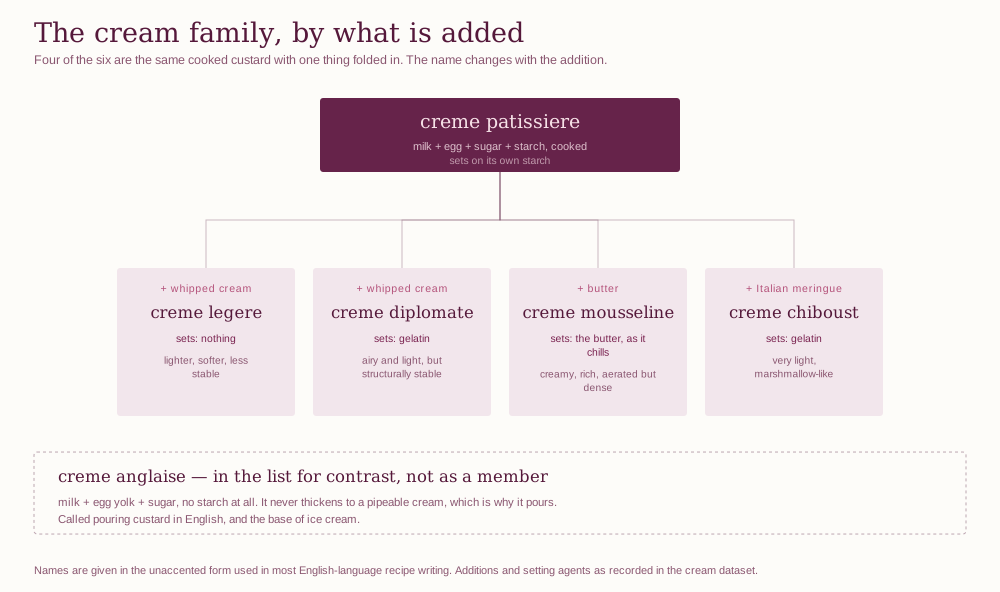
Crème pâtissière is the base of an entire family; crème anglaise is the contrast case that sits outside it. The six members and their one distinguishing addition each are tabulated on the crème pâtissière page, and the lightest of them, pastry cream with whipped cream folded in, is crème légère.
One British complication worth naming: “custard” in a British kitchen most often means the pouring kind out of a tin or a packet, which is starch-thickened and coloured, and so it is neither of the two above. A riz au lait is a third thing again: a milk pudding thickened by the starch in the rice itself.
Questions about custard without cornflour
Can you make custard without cornflour?
Yes. That is crème anglaise: milk, egg yolk and sugar, thickened by the yolk alone. It pours rather than pipes, and it curdles if boiled.
What does cornflour do in custard?
Two things. It gelatinises to give a body the egg cannot reach, and it protects the egg, which is why a starch custard can be boiled and a starchless one cannot.
How do I thicken custard without cornflour?
More yolk gets you a richer sauce but never a pipeable one. Plain or rice flour substitutes within the same mechanism. If it has to hold a shape, gelatin is the honest answer and the result is a bavaroise rather than a custard.
Why did my custard curdle?
It went past coagulation. Without starch to protect the yolk there is no margin above the point where it coats a spoon, and the change is permanent.
Is crème anglaise the same as custard?
It is one custard. British custard usually means the starch-thickened pouring kind, and the thick filling in a tart is crème pâtissière, which is also starch-set. All three get called custard.