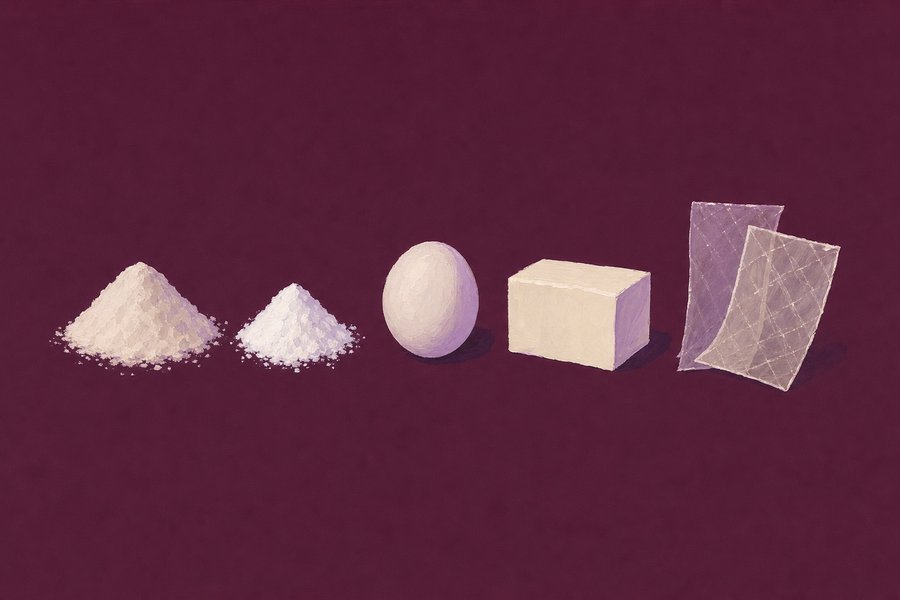
Five mechanisms, one word
“It sets” describes five unrelated pieces of physics. A jam holds its shape because pectin chains have bonded into a network; a pastry cream because starch granules have swollen and gelatinised; a curd because egg protein has coagulated; a ganache because fat has crystallised on cooling; a mousse because a hydrocolloid has formed a gel. Nothing about one of those predicts anything about another.
Which is why the common substitutions fail in specific, repeatable ways. Adding lemon juice to a filling that sets on egg makes it sharper and no firmer. Boiling a ganache longer does not thicken it. Adding pectin to a pastry cream does nothing at all, because there is no acid and no free water for it to work in.
| Sets on | What it makes | What it needs | Reversible |
|---|---|---|---|
| Pectin | a preserve | acid and sugar, both | no; it will not re-set once broken |
| Starch | a cooked cream | heat, held long enough to gelatinise | partly; it loosens when stirred, and re-thickens on cooling |
| Egg | a custard or a curd | heat, and stopping before it curdles | no; coagulation is one-way |
| Fat | a ganache or a truffle | nothing but cooling | yes; it melts and re-sets |
| Gelatin and other hydrocolloids | a mousse or a jelly | hydration, then cooling | gelatin yes, agar no |
Pectin against gelatin, which is the comparison people mean
They are asked about together because both make a wobble, and they have almost nothing else in common. Pectin comes from fruit, needs acid and a high sugar concentration to work at all, sets as the pan cools and cannot be melted and re-set. Break the network and it is gone. Gelatin comes from animal collagen, needs neither acid nor sugar, sets in the fridge and melts again on warming, which is why a gelatin dessert can be re-worked and a jam cannot.
Two consequences worth having straight. Gelatin is not vegetarian and pectin is. Agar, from seaweed, is the usual vegetarian stand-in for gelatin, and it sets firmer and does not melt back the same way, so it is not a one-for-one swap either. And a fruit jelly made with gelatin is a different product from a fruit gelée made with pectin, however similar the two look in a mould.
Where the fruit itself decides the answer, the figures are per fruit: 34 of them, with pectin class and measured acidity kept apart, in the register. The substance itself is under pectin, and the three conditions it needs are in the preserves section.
The creams are the clearest case
The pastry-cream family is one base with different agents added, so it shows the whole principle inside a single family. The base sets on starch. Fold whipped cream in and nothing new sets it: that is crème légère, and it is the loosest of them. Set the base with gelatin first and then lighten it and you have crème diplomate, which holds a tall structure. Lighten it with butter instead and the butter sets it on chilling: crème mousseline.
2 of the 6 members use gelatin, and that single difference is what separates the two that look most alike. The family table is on the crème pâtissière page; the member with no starch at all is crème anglaise.
Two more worth naming, because they are so often misread
A ganache sets on fat and on nothing else. It needs no heat past melting, no acid, no starch and no time, only cooling, and it is the only member of this list that re-sets after being melted as often as you like.
A lemon curd or lemon square topping sets on egg, which catches people out precisely because lemon is the fruit this site recommends for making other things set. The acid in it is doing nothing structural. The egg is the whole mechanism, and the way to ruin one is to take it past coagulation rather than to under-acidify it.
Questions about setting agents
What is the difference between pectin and gelatin?
Pectin comes from fruit, needs acid and sugar, and cannot be re-melted once set. Gelatin comes from collagen, needs neither acid nor sugar, and melts and re-sets freely. Pectin is vegetarian; gelatin is not.
Can I use gelatin instead of pectin in jam?
It will make something that wobbles, but not a jam: it will melt in a warm room, it does not keep like a preserve, and the EU definitions of jam are written around the concentration a pectin set requires. They are different products.
Is agar the same as gelatin?
No. Agar is from seaweed and is vegetarian, sets firmer, and does not melt back in the mouth the way gelatin does. It substitutes for gelatin in principle but not one for one.
What sets a pastry cream?
Cooked starch. It has to be held at heat long enough for the starch to gelatinise. That is the step, not the eggs and not the chilling.
Why will my ganache not thicken?
Because a ganache sets on fat as it cools, so nothing done in the pan thickens it. The variable is the ratio of chocolate to cream, and the fix is more chocolate rather than more time.