What thickens it
Riz au lait is rice cooked slowly in sweetened milk until the starch thickens the milk around it. It is a stovetop dish, stirred, and it is finished when the liquid has thickened rather than when a time is up.
The mechanism is one this site keeps arriving at. Starch cooked in liquid gelatinises and thickens what it is suspended in, which is what sets a pastry cream, and what a water roux does before it goes into a dough. The only difference here is where the starch comes from: it is inside the grain rather than added as flour.
Which explains the two practical rules that every version of this dish shares. It has to be stirred, because the starch settles and scorches. And it thickens further as it cools, so it comes off the heat looser than it will be served.
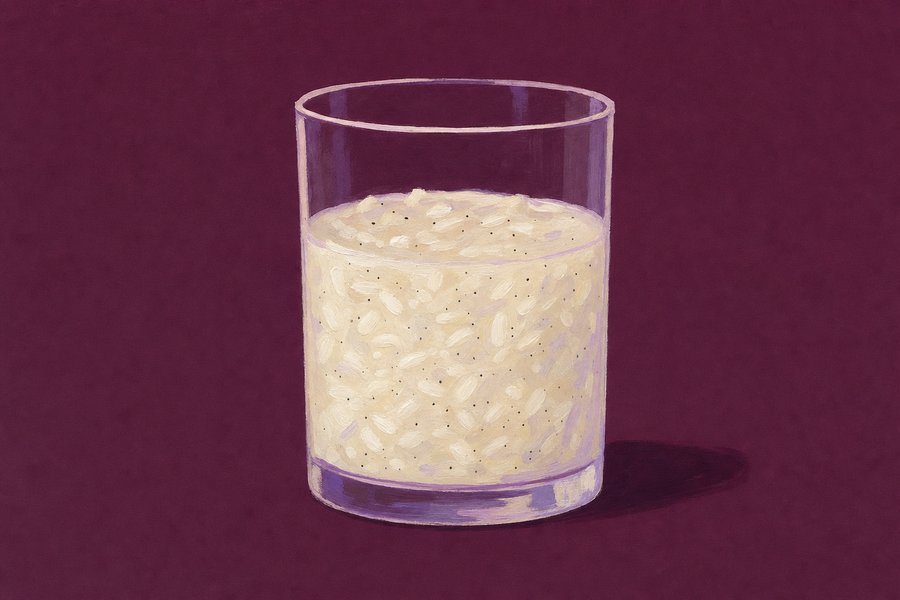
Two dishes, one English name
English rice pudding covers riz au lait and something else: the baked version, put in a low oven for a long time and served with the browned skin that forms on top. Those are not variants of one preparation. One is stirred on a hob and stays pale and creamy; the other is left alone in an oven and is partly defined by the skin.
So a recipe found under the English name may produce either, and the two have different failure modes. A stovetop pudding scorches if unstirred; a baked one does not, but curdles if the oven is too hot. Anyone following a translated recipe should establish which dish it is before deciding what went wrong.
This is a milder case of the same problem as several other pages here, where a single word in one language covering two preparations in another. The terms this site borrows are collected in the glossary.
What the mechanism predicts, and what it does not
Reading this as a starch dish rather than as a rice dish makes two things predictable and marks a third as unanswerable.
Predictable: it needs a long, low cook, because starch has to hydrate and gelatinise gradually and a hard boil drives off milk faster than the grain can absorb it. And it cannot be rushed by adding flour or cornflour to thicken the milk. That produces a rice pudding suspended in a pastry cream, which is a different dish with a different texture, not a shortcut to this one.
Not answerable here: which rice. More available starch should mean more thickening, and that points at the short-grain rices, but nothing consulted for this page compares varieties or gives a figure, so no variety is recommended and no ratio is stated. It is recorded as an open question in the same way the register leaves twelve of thirty-four pectin readings empty rather than estimating them.
What the vanilla is doing
Vanilla in a riz au lait is infused into the milk rather than stirred in at the end, and that is a consequence of the mechanism rather than a preference: the milk is hot for a long time, which is exactly the condition an infusion needs, and there is no later stage at which something delicate could be added without being cooked anyway.
What quantities are right, meaning the rice-to-milk ratio, the sugar and the cooking time, is not established on this page. Nothing consulted specifies them, so none are given. What the page can establish is what thickens the dish, which is the part that explains the technique.
Questions about riz au lait
What thickens riz au lait?
The rice’s own starch. Cooked in the milk it gelatinises and thickens the liquid around it, the same event as cooking out the starch in a pastry cream, with the starch arriving inside the grain rather than as flour.
Why does it need constant stirring?
Because the starch and the rice settle to the bottom of the pan and scorch. It is a stovetop dish, and the stirring is not optional.
Is riz au lait the same as rice pudding?
Partly. English rice pudding covers both this stirred stovetop dish and the baked version with a browned skin, which is a different preparation with different failure modes under the same name.
Should it look thick when it comes off the heat?
No, looser than it will be served. It thickens further as it cools, so a pudding that looks right in the pan will be stiff by the time it is eaten.