The bath is the recipe
A pretzel is a knotted bread dipped in an alkaline solution before baking. That dip is what gives it its dark, glossy, faintly bitter crust, and it is the whole of what distinguishes it: skip the bath and the same dough bakes into something much closer to a breadstick.
Which is worth stating first because it is where most attention goes wrong. The knot is recognisable but decorative. The dough is an ordinary lean bread dough. The step that determines the result is a thirty-second dip that many recipes treat as optional.
The site’s own variable, running the other way
Almost everything on this site rests on pH used as acid. The fruit register measures how acid thirty-four fruits are, because that decides whether a preserve will set and whether it is acid enough to can. The 4.6 line running through the preserving pages is a pH threshold.
A pretzel is the same variable at the opposite end of the scale. Raising the pH at the dough’s surface accelerates the Maillard reaction, the browning of amino acids and sugars, so the crust colours far faster and much darker than a neutral surface would at the same temperature. It also partly gelatinises the starch at the surface, which is where the taut, glossy skin comes from, and tightens the outer layer.
So this is the one page here where pH is not about whether something sets, but about what colour and texture a surface takes. Same measurement, opposite direction, entirely different question, which is a reasonable argument for keeping the acid and the alkali sides of it distinguishable rather than talking about “pH” as though it meant one thing.
Lye against bicarbonate, and what is actually established
Lye, or sodium hydroxide, is far more alkaline than bicarbonate of soda, and the difference shows. A dough treated with a bicarbonate solution is consistently reported to come out closer to a breadstick in colour, taste and texture: recognisably the same shape, not recognisably a pretzel. Baked bicarbonate and calcium hydroxide are the usual safer substitutes, sitting between the two.
The direction of that difference is well supported: everyone who compares them reports it the same way. The magnitudes are not. Nothing consulted for this page measured a surface pH, a browning rate or a crust thickness, so no figures are given here. What surface pH the bath actually reaches, and how much of the effect is browning against how much is the starch skin, are both not established.
The fourth time starch does this
Surface starch gelatinising in an alkaline bath is the fourth appearance of one physical event on this site. It sets a pastry cream. It holds the water in a dough as a water roux. It thickens a riz au lait from inside the grain. And here it forms a skin on the outside of a bread. Cooking starch in liquid until it swells is the same thing every time; what changes is where it happens and what the result is for.
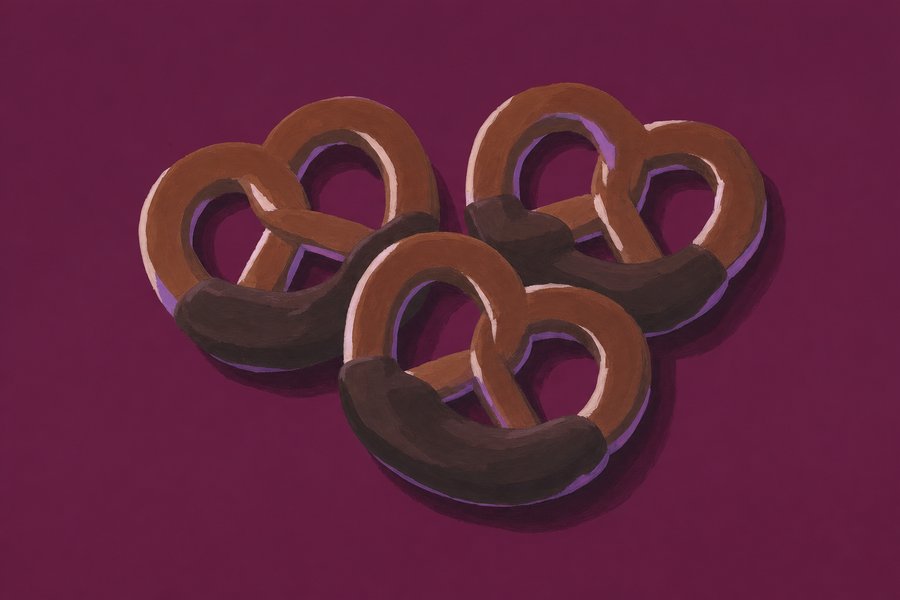
Dipping the finished pretzel in chocolate, as this page’s original subject did, changes none of the above. It is a coating on a finished bread, and the crust it sits on was decided before the oven.
Questions about pretzels
What does the alkaline bath do to a pretzel?
Two things. It raises the pH at the surface, which accelerates Maillard browning so the crust colours faster and darker; and it partly gelatinises the surface starch, which is where the taut glossy skin comes from.
Can baking soda replace lye?
It can, and the result is different. Lye is far more alkaline, and a bicarbonate-treated dough is consistently reported to come out closer to a breadstick in colour, taste and texture. Baked bicarbonate and calcium hydroxide sit between the two.
What happens if the bath is skipped?
The same dough bakes into something much closer to a breadstick. The dip is not a finishing touch, and it is the step that makes a pretzel a pretzel.
How alkaline does the surface actually get?
Not established. No source consulted measured a surface pH or a browning rate, so the direction of the effect is well supported while the magnitudes are not.