The set, and what actually separates them
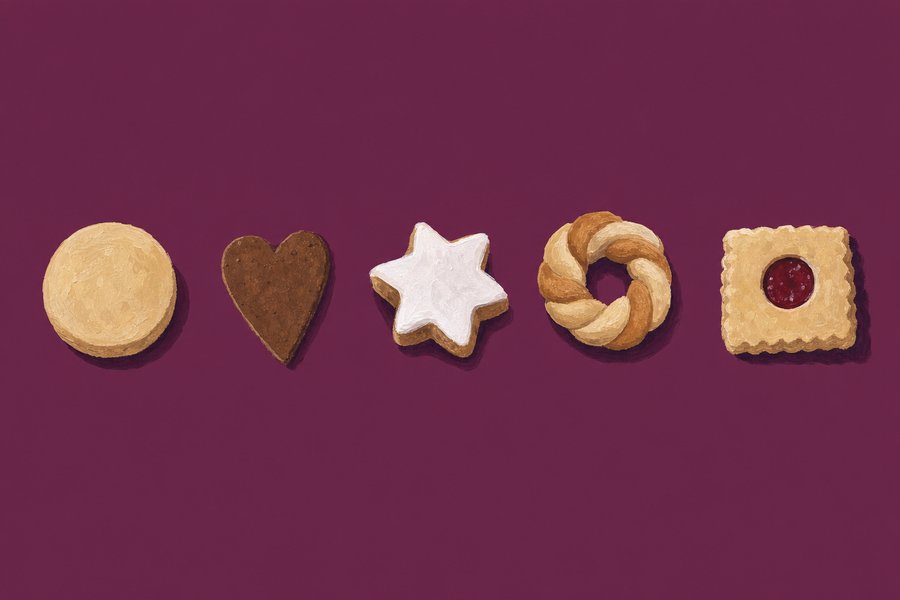
The Northern European Christmas baking season runs from Advent to Christmas, and the cast is small and consistent. What is useful about seeing them together is that each one is defined by a different variable, not by being a variation on the others.
Pepparkakor are defined by texture: thin and snapping, which is what lets the same dough build a house. Zimtstern are defined by an absence: ground almond and egg white, typically no wheat flour at all. Lussekatter are defined by a spice used in quantity, saffron, which is doing colour as well as flavour. Honungssnittar are defined by a method: baked as lengths and cut on the diagonal afterwards.
Four bakes, four different kinds of definition. Which is why a page that treats them as interchangeable Christmas biscuits misses what each one is actually about.
Trap one: a spice bought under the wrong name
The single most consequential mistake in this season is not a technique. Swedish kummin is caraway; spiskummin is cumin. German has the same pair, Kümmel and Kreuzkümmel, and French cumin, Spanish comino and Dutch komijn all mean cumin. So a shopper working from a translated ingredient list can very easily buy the wrong jar, and cumin in a Swedish rye is not a subtle error.
The full ingredient glossary, with the false friends flagged, sits with the Nordic section.
Trap two: a saffron dose read as absolute
Saffron is the only spice in this set used in a quantity that matters measurably, and published recipes disagree. Normalised to grams per kilogram of flour, the recorded figures run from 0.83 to 1.67 g/kg, with a median of 1.17 across 4 recipes.
Which is a range and is reported as one. A single number taken from a single recipe and treated as the correct dose is the error; four recipes do not support narrowing it further, and the dosage question is handled properly at baking with saffron. The bun that carries it without the required shape is at saffransbullar.
Trap three: a dough that bends
The third is structural and specific to the gingerbread house. A pepparkaka dough has to snap rather than bend, because the same dough is rolled and cut as flat panels for a pepparkakshus, and a panel that flexes will not hold its own weight as a wall.
So “too soft” is a failure with two quite different consequences depending on what the dough is for: a slightly disappointing biscuit, or a house that sags. The texture is the specification.
The wider biscuit terminology, including why a biscuit and a cookie are not the same word across the Atlantic, is at biscuits and cookies.
Questions about the Christmas set
Which biscuits belong to the Northern European Christmas set?
Pepparkakor, zimtstern, honungssnittar and the saffron buns, meaning lussekatter and saffransbullar. Each is defined by a different variable: a texture, an absence of flour, a method, and a spice used in measurable quantity.
How much saffron goes into a batch?
The published figures, normalised to grams per kilogram of flour, run from 0.83 to 1.67 g/kg with a median of 1.17 across four recipes. It is reported as a range because four recipes do not support a single number.
What is the most common mistake?
Buying the wrong spice. Swedish kummin is caraway and spiskummin is cumin, and German, French, Spanish and Dutch all have words that look like one and mean the other.
Why does pepparkaka dough have to be so thin and hard?
Because the same dough builds a pepparkakshus, and a panel that bends will not hold its own weight as a wall. For a flat biscuit softness is a disappointment; for a house it is a structural failure.