What are saffransbullar?
A saffron enriched-wheat bun; the same dough family as lussekatt, not always coiled. The name simply means saffron bun: saffran plus bulle, the general Swedish word for a bun. They belong to advent and christmas, the same season as their better-known relative.
The relationship to the lussekatt is worth stating precisely, because English-language sources often treat the two as different recipes. They are the same dough. A saffron-yellow enriched wheat bun, usually coiled into an S with a raisin in each eye. A saffransbulle is that dough without the required coil, so it can be rolled, filled, plaited, baked in a tin, or shaped in any of the ways an ordinary sweet bun can be.
That freedom is the whole point of the distinction. The lussekatt's shape is fixed by the occasion, and a shape fixed by occasion cannot hold a filling. Once the obligation is lifted, the dough becomes a base for everything the Swedish bun repertoire does with cardamom dough.
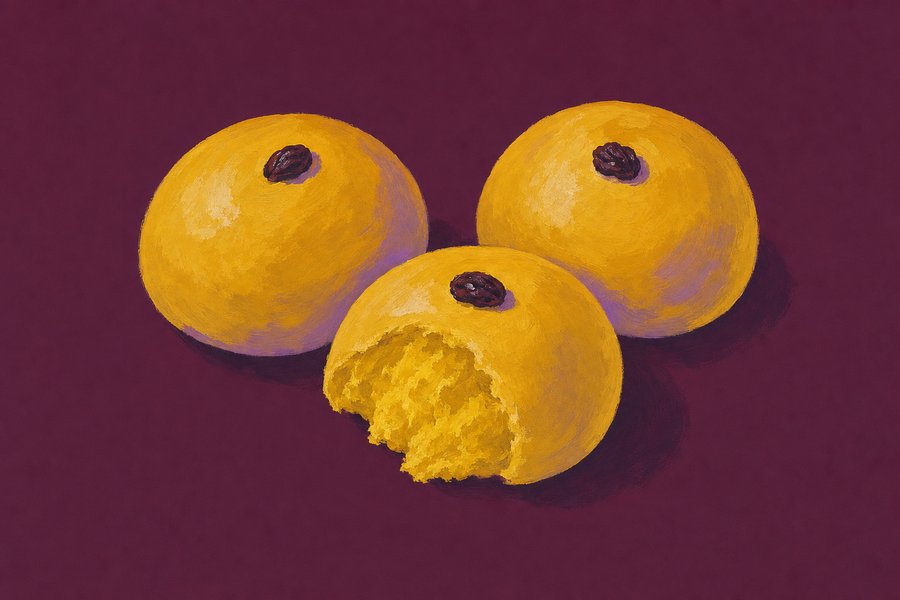
Where the almond comes in
Almond paste is the standard filling for a saffron bun that is not a lussekatt, and it is a genuine pairing rather than an arbitrary one: almond and saffron are both used across the same Advent baking, and the almond's fat carries saffron's aromatics well.
The ingredient is worth naming carefully, because three different products get called almond paste in English. Mandelmassa is the Swedish baking paste, a high proportion of almonds to sugar, used as a filling. Marzipan is sweeter with less almond and is used for covering and modelling. And ground almonds with sugar beaten in is a home approximation of the first, not of the second. A filling recipe assuming mandelmassa and made with marzipan will be markedly sweeter and looser.
Pearl sugar, and why nothing substitutes for it
Most of these buns are finished with pearl sugar, perlsocker, and it has no real substitute. It is a coarse compressed sugar that resists melting, so it stays as visible white grains on the crust rather than dissolving into it. Granulated sugar disappears; icing sugar burns; demerara melts and goes sticky.
Where it is unavailable, leaving it off is closer to the original than replacing it. A saffransbulle without pearl sugar is a plainer version of itself; one finished with the wrong sugar is a bun with a caramelised patch on top.
What the dough asks for
Being enriched with butter, egg, sugar and often quark, the dough is slack, proves slowly and prefers a long cold rest to a warm fast one. That is a property of the enrichment rather than a preference, and it is shared with every rich bun dough.
Shaping is where the freedom actually gets used. The common forms are a rolled spiral with the filling inside, a plaited or knotted bun, and a tray-baked slab cut into squares after baking. All three hold filling, and all three are impossible in a lussekatt's coil, which is the practical reason the two names exist for one dough rather than a matter of regional preference.
Cardamom is the other spice worth mentioning, because it is where the Swedish bun repertoire divides. Saffron and cardamom are the two enriched bases most Swedish sweet buns are built on, and they are not usually combined: saffron belongs to Advent while cardamom runs all year. A recipe calling for both is doing something deliberate rather than following a convention.
The saffron itself has to be steeped rather than added dry, or the colour comes out speckled and most of an expensive ingredient stays locked in the stigma. The dose, the forms to buy and the steeping are covered at baking with saffron; the naming history of the coiled version is at lussekatter; and the wider repertoire is in the Nordic section.
Questions about saffron buns
What is the difference between saffransbullar and lussekatter?
The shape and the obligation, not the dough. A lussekatt is coiled into an S with a raisin in each eye and belongs to Lucia on 13 December. A saffransbulle is the same dough without the required shape, which is why filled and plaited versions exist.
Can I fill a lussekatt?
Not really. The coiled shape is what makes it a lussekatt, and it has nowhere to hold a filling. A filled saffron bun is a saffransbulle, which is the same dough shaped freely.
Is mandelmassa the same as marzipan?
No. Mandelmassa is the Swedish baking paste with a high proportion of almonds to sugar, used as a filling. Marzipan is sweeter with less almond and is meant for covering and modelling. Substituting it gives a sweeter, looser filling.
What can I use instead of pearl sugar?
Nothing, really. It is a coarse compressed sugar that resists melting and stays as white grains on the crust. Granulated disappears, icing sugar burns, demerara melts sticky. Leaving it off is closer to the original than replacing it.
Why is the dough so slack?
Butter, egg and sugar all slow the yeast and weaken the gluten network. That is what an enriched dough is, and it is why these doughs want a long cold rest rather than a warm quick prove.