The dough already has it
The dataset records cardamom as The defining spice of kanelbulle dough. That is, the spice is in the dough of a cinnamon bun before any filling is rolled into it. So the difference between a kanelbulle and a kardemummabulle is not the presence of cardamom. It is where the cardamom is and how much of it there is: a cardamom bun puts it in the filling as well, in quantity, instead of cinnamon.
A kanelbulle itself is an enriched wheat bun - flour, milk, yeast, sugar, butter, usually cardamom - rolled up with a filling of butter, sugar and cinnamon, and commonly finished with pearl sugar and sometimes flaked almond. Formed as a cut spiral, or tied as a knot, or cut on the slant as a korvapuusti.
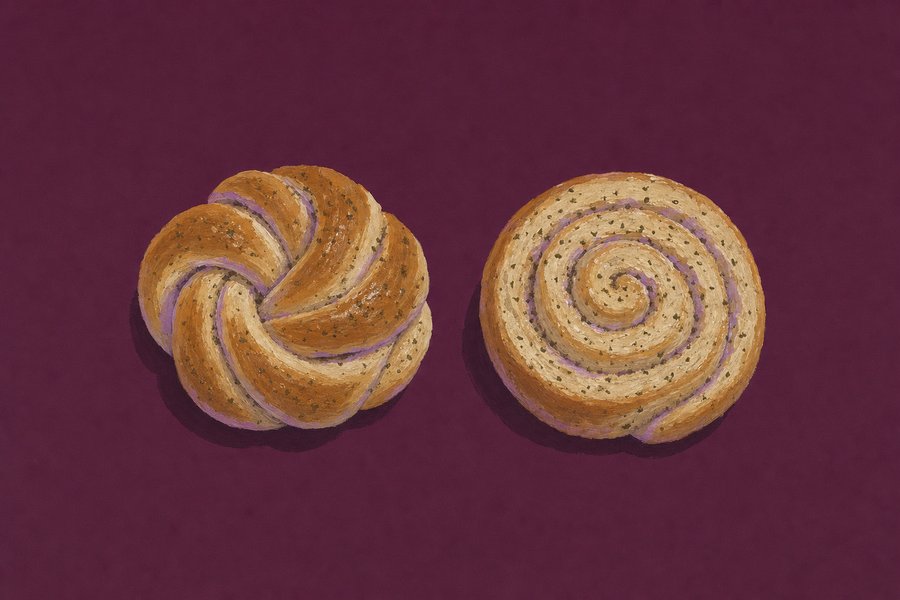
What actually changes
The filling. Butter, sugar and cardamom rather than butter, sugar and cinnamon. Nothing structural changes, which is why the two buns share a shaping vocabulary and a proving time and everything else about them.
The dose. This is the part that catches out anyone working from an English recipe. The sources note plainly that Swedish recipes use far more cardamom than English ones do, and a cardamom bun made to an English hand is a cinnamon bun with a hint of something. Freshly ground pods rather than pre-ground powder makes a larger difference here than it does in a spiced biscuit, because there is no second spice to hide behind.
Not the finish. Pearl sugar goes on both, after the egg wash, and often flaked almond with it.
The knot, which is not a cardamom feature either
Cardamom buns are usually photographed as knots, and the knot has become a visual shorthand for them. It is not a property of the filling. The dataset records the same bun as formed as a cut spiral, or tied as a knot, or cut on the slant, and all three shapings are used for cinnamon and cardamom alike. A knotted cinnamon bun is entirely ordinary in Sweden.
The third shaping in that list is a different bun with a different name: korvapuusti is the Finnish version, Finnish cinnamon bun, cut on the slant, and the dataset notes its cardamom is more pronounced than in the Swedish version than the Swedish one. So the most cardamom-forward bun of the three is the one named after neither spice.
When they are eaten
Year-round, like the cinnamon bun, and for the same reason: these are fika buns rather than calendar bakes, unlike the saffron buns that belong to Advent and Lucia. There is no cardamom-bun day. The cinnamon bun has one, Kanelbullens dag, 4 October — and it is a modern trade promotion rather than a traditional feast, which is worth knowing before treating it as folklore.
Swedish baking terms, with the traps that matter, are in the Nordic section; the wider vocabulary is in the glossary.
Questions about cardamom buns
What is a cardamom bun?
A Swedish sweet bun with cardamom in the filling as well as in the dough. The dough of a cinnamon bun already contains cardamom, so the difference is the filling and the quantity, not the ingredient.
Is a cardamom bun the same as a cinnamon bun?
Same dough, same shaping, same finish. The filling is butter, sugar and cardamom instead of butter, sugar and cinnamon.
What is a cardamom bun called in Swedish?
Kardemummabulle. The spice itself is kardemumma, ground cardamom being kardemumma (malen).
Why does my cardamom bun taste of so little cardamom?
Almost always the dose. Swedish recipes use considerably more cardamom than English ones, and freshly ground pods carry much more than pre-ground powder.
Do cardamom buns have to be knotted?
No. The same bun is made as a cut spiral, as a tied knot, or cut on the slant, and all three are used for cinnamon buns too. The knot is a shaping, not a recipe.