What fika is
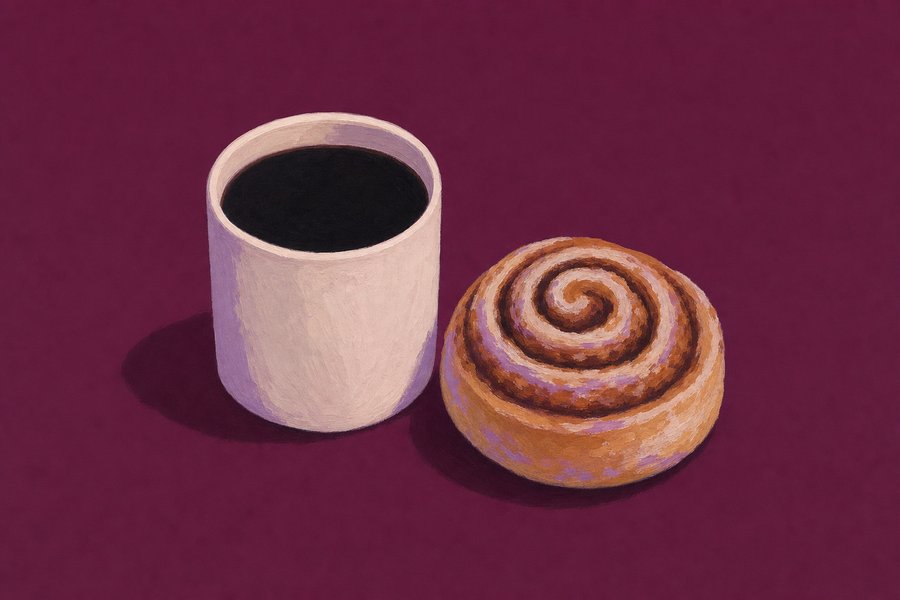
Fika is a coffee break taken as a social occasion rather than as a pause: coffee with something baked, sitting down, with other people, and often at a fixed time of day. It works as both noun and verb in Swedish, so one can have a fika or simply fika, and in workplaces it is frequently scheduled rather than incidental.
That matters for the baking because it defines the format. Fika wants something that can be eaten with one hand alongside coffee, that keeps for a day or two, and that is sweet without being a dessert. Almost the whole Swedish home-baking repertoire fits that description, and the things that do not, the celebration cakes and the puddings, sit outside fika rather than at it.
There is also a distinction worth knowing between everyday fika and its expanded form, where several kinds of baking are put out together. The everyday version is one thing with coffee; the larger version is closer to an afternoon tea and is where the biscuit tins come out.
What gets eaten
The staples are enriched sweet buns and biscuits. The dough divides on spice: cardamom runs all year and saffron belongs to Advent, and those two bases carry most of the bun repertoire between them.
- lussekatt — A saffron-yellow enriched wheat bun, usually coiled into an S with a raisin in each eye. Lucia (13 December) and through Christmas.
- kavring — A dark, sweet, close-crumbed rye bread, originally from Skane. year-round.
- saffransbulle — A saffron enriched-wheat bun; the same dough family as lussekatt, not always coiled. Advent and Christmas.
Bread sits slightly apart. A kavring is a bread rather than fika baking, eaten with savoury food, but it belongs to the same kitchen and shares its spicing habits, which is why caraway and bitter orange turn up across both.
The seasonal structure is the thing an outside reader most often misses. Saffron baking is December, so a lussekatt in June reads as odd rather than merely unseasonal; the filled saffron buns follow the same calendar. Cinnamon and cardamom have no such restriction.
The words that trip up a translation
Two more habits worth knowing, because they are assumed rather than stated in Swedish recipes. Pearl sugar finishes a great many of these buns and has no real substitute: it is a coarse compressed sugar that resists melting and stays as visible white grains, where granulated dissolves and icing sugar burns. And filmjölk, a soured milk, appears in a lot of everyday baking for its acidity and the tenderness it gives, with buttermilk or thinned yoghurt the usual stand-ins outside Sweden.
The doughs are also enriched to a degree that surprises anyone used to lean bread. Butter, egg and sugar all slow the yeast and weaken the gluten, so these are slack, slow-proving doughs that reward a long cold rest rather than a warm quick one, which is why so many Swedish recipes start the evening before.
Swedish baking is unusually easy to get wrong at the shop rather than at the oven, because two of its defining spices have names that map onto each other's opposites in other languages. The single most damaging is kummin, which is caraway, while spiskummin, with the prefix, is cumin.
| English | Swedish | Botanical |
|---|---|---|
| caraway (seeds) | kummin | Carum carvi |
| cumin (seeds) | spiskummin | Cuminum cyminum |
| fennel (seeds) | fankal (fankalsfron) | Foeniculum vulgare |
| anise | anis | Pimpinella anisum |
| bitter orange (peel) | pomerans | Citrus x aurantium |
| cloves (ground) | kryddnejlika (malen) | Syzygium aromaticum |
| ginger (ground) | ingefara (malen) | Zingiber officinale |
| cardamom (ground) | kardemumma (malen) | Elettaria cardamomum |
| saffron | saffran | Crocus sativus |
| bread flour (strong) | vetemjol special | — |
| rye flour (wholemeal) | ragmjol | — |
| sifted rye + wheat blend | ragsikt | — |
| soured milk | filmjolk | — |
Naming by botanical species is the only unambiguous route across languages. The whole Swedish repertoire is in the Nordic section, and saffron itself at baking with saffron.
Questions about fika and Swedish baking
What is fika?
A coffee break taken as a social occasion: coffee with something baked, sitting down, with other people, often at a fixed time. It works as both a noun and a verb in Swedish, and in workplaces it is frequently scheduled rather than incidental.
What is normally eaten at fika?
Enriched sweet buns and biscuits, the things that can be held in one hand alongside coffee keep for a day or two. Cardamom-spiced buns run all year; saffron ones belong to Advent.
Is kummin cumin or caraway?
Caraway. Cumin is spiskummin, with the prefix. This is the most damaging translation error in Swedish baking, and it happens at the spice shelf rather than in the kitchen.
Why is saffron baking only done in December?
Because the tradition attached itself to Advent and Lucia, and saffron is expensive enough that it stayed a once-a-year ingredient. A saffron bun out of season reads as odd in a way a cinnamon one does not.
Is bread part of fika?
Not really. A dark rye like kavring is eaten with savoury food rather than with coffee. It belongs to the same kitchen and shares the spicing habits, but not the occasion.