How much: a range, not a number
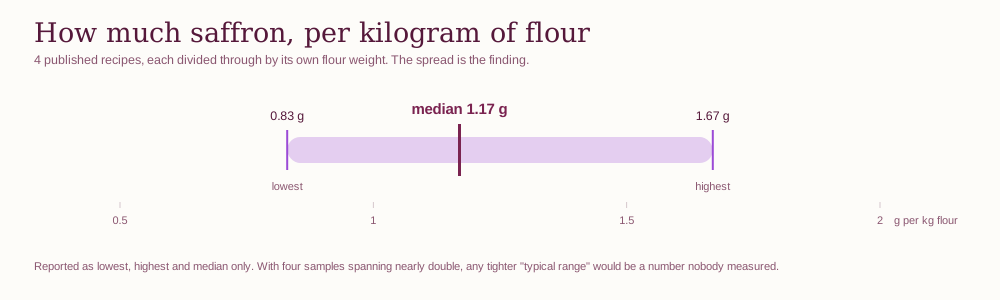
Measured across 4 published recipes and normalised to a common basis, saffron in an enriched dough runs from 0.83 to 1.67 grams per kilo of flour, median 1.17. The unit matters: g saffron per kg flour.
It is quoted as a range deliberately. With four samples spanning nearly a factor of two, a single figure or a tight “typical” band would be invented precision. The spread is real rather than noise. It is the difference between a pale bun and an assertive one, and where to sit in it is a decision rather than an error.
Secondary sources describe most traditional recipes as clustering near 1 to 1.3 g per kilo. That is worth knowing and worth attributing to them: four samples do not have the numbers to confirm a cluster, so it is repeated here as somebody else's observation rather than as a finding.

Why Swedish recipes look inconsistent
Swedish shops sell saffron in 0.5 g sachets, which is why Swedish recipes are written per sachet. One sachet against 500 g flour sits at 1.0 g/kg - the bottom of the typical range.
Which means a recipe saying “one sachet” is not specifying a dose at all. It is specifying a purchase. One 0.5 g sachet against 500 g of flour is 1.0 g per kilo, near the bottom of the range; the same sachet against 300 g of flour is well over the top of it. Converting any recipe to grams per kilo of flour before comparing it to another is the only way to see what it is actually asking for.
Threads or powder
Saffron is sold as whole dried stigmas, called threads, and as powder. Threads are the safer purchase for one straightforward reason: you can see what you have bought. Powder is easy to adulterate with turmeric, safflower or paprika, all of which are yellow and none of which taste of saffron, and adulteration is not detectable by eye once ground.
Powder does disperse more readily and needs no grinding, which is a real convenience. The practical compromise most Nordic bakers use is to buy threads and grind them, usually with a pinch of the recipe's sugar in a mortar, which gives an abrasive to work against and stops the threads simply flattening.
The mistake that wastes it: adding it dry
Saffron's colour and most of its flavour compounds are water-soluble and need time and liquid to come out. Threads added dry to a dough will colour the crumb unevenly, leaving visible yellow specks in pale bread, and much of what was paid for stays locked in the stigma.
The standard practice is to steep it first: grind it, then let it stand in a little of the recipe's warm liquid, or in a spoonful of spirit, for a period before mixing. Warm rather than hot; boiling liquid drives off aromatics. Longer is better and overnight is common in Swedish home baking, which is also why saffron doughs are so often started the evening before.
Storage decides whether the money was well spent. Saffron loses aroma to light and air rather than to time as such, so an airtight container in the dark keeps it usable for years while an open jar on a sunny shelf is spent within months. Buying a large quantity cheaply is a false economy unless it is stored properly, and a small sachet each December is often the better purchase.
One consequence worth flagging: because the colour develops during steeping, judging the dose by the colour of the dough before it has stood is misleading. The dough will darken. Adding more saffron because the dough looks pale is how an expensive ingredient gets doubled unnecessarily.
The buns this is usually for are covered at lussekatter, and the wider Swedish repertoire in the Nordic section.
Work out a dose
The band above is per kilo of flour. This is that band at the weight you are actually mixing, and, because saffron is sold in 0.5 g sachets rather than by the gram, how many packets that comes to. It reports three figures and not one: the lowest and highest of the 4 published recipes the norm was derived from, and their median. A single recommended number would be invented precision from 4 samples spanning a factor of two.
For 500 g of flour
- Lowest of the 4
- 0.42 g0.83 g/kg
- Median
- 0.59 g1.17 g/kg
- Highest of the 4
- 0.84 g1.67 g/kg
In sachets, which is how it is sold
- 1 × 0.5 g 1.00 g/kg inside the observed band
- 2 × 0.5 g 2.00 g/kg above everything observed
- 3 × 0.5 g 3.00 g/kg above everything observed
What each of the 4 recipes would use at this weight
- 0.42 g 0.83 g/kg 0.5 g to 600 g flour: 0.5 g against 600 g vetemjol special
- 0.5 g 1.00 g/kg 0.8 g to 800 g flour: 0.8 g powder, standard batch
- 0.67 g 1.33 g/kg 1 g to 750 g flour: 1 g threads, 25 buns
- 0.84 g 1.67 g/kg 1 g to 600 g flour: 1 g, powdered or whole
Why three numbers and not one
The band is derived, not published: each of the 4 recipes was divided by its own flour weight and normalised to a kilo, because recipes written for different batch sizes cannot be compared as written. That gives 0.83 g/kg to 1.67 g/kg, median 1.17 g/kg, a spread of roughly two to one across 4 samples. Narrowing that to a tidier range would be inventing precision the sources do not support, so it is reported as it came out.
The spread is also not only a matter of taste. Saffron strength varies with harvest and with form: threads that have to give their colour up in liquid behave differently from a powder that disperses immediately, and the same weight of a weaker crop is a paler bun. That is why the top of this band is not an error to be corrected downwards.
Secondary sources describe most traditional recipes as clustering nearer 1–1.3 g/kg. Two of these 4 fall inside that, which is not enough to confirm it either way, so it is repeated here as their claim, not as a measurement.
Sachets are the reason Swedish recipes look inconsistent when you compare them: one 0.5 g packet against 500 g of flour is 1.00 g/kg, near the bottom of the band, and the same packet against 300 g is 1.67 g/kg, above everything measured here. The packet does not change; the flour does.
Questions about saffron
How much saffron per kilo of flour?
Between 0.83 and 1.67 grams across the recipes measured here, median 1.17. It is given as a range because four samples spanning that much do not support a single figure, and because the spread is a real choice about strength.
Should I buy threads or powder?
Threads, because you can see what you bought. Powder is easily adulterated with turmeric or safflower and adulteration is undetectable once ground. Grinding threads with a pinch of the recipe’s sugar gives something to work against.
Do I need to steep saffron before adding it?
Yes. The colour and most of the flavour are water-soluble and need liquid and time. Added dry, it speckles the crumb and much of what you paid for stays in the stigma. Steep it in a little warm liquid, though not boiling, which drives off aromatics.
Why does a Swedish recipe say “one packet”?
Because Swedish shops sell saffron in 0.5 g sachets, so recipes are written per sachet. That is a purchase rather than a dose: one sachet against 500 g of flour and against 300 g are very different strengths.
My dough looks pale. Should I add more?
Probably not. The colour develops as the saffron steeps and continues to deepen, so judging by the dough before it has stood underestimates it. This is the usual reason an expensive ingredient gets doubled for no benefit.