What are honungssnittar?
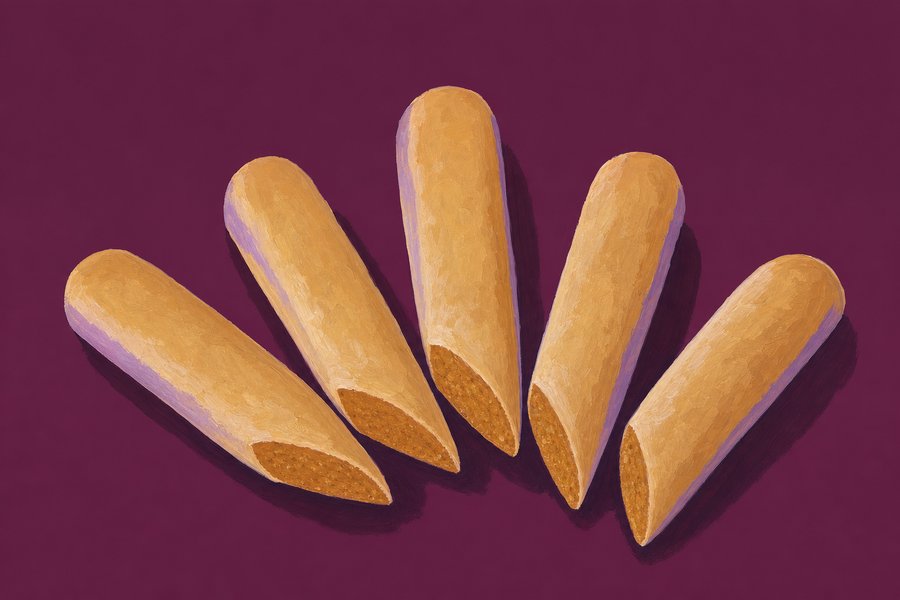
Honungssnittar are honey biscuits, and they belong to a family the name gives away. The dough is not portioned into rounds and it is not cut with a cutter. It is rolled into long flat lengths, baked as lengths, and then cut on the diagonal into pieces of roughly two centimetres while still warm.
Snitt is the cut. That is what the suffix records, and it is why the finished biscuit is a slanted bar with two angled ends rather than a disc, because the shape is a by-product of how it was divided, not a shape it was formed into.
Which reframes the whole group. If -snittar named a flavour or a dough, the family would be a set of variations. It names the method, so the family is one biscuit made four ways, and the differences between its members are entirely in what sweetens them.
| Name | What sweetens it | Note |
|---|---|---|
| kolasnittar | light syrup | The most commonly baked of the set, and the one the name is most often attached to. |
| chokladsnittar | chocolate | The same log, flavoured through the dough rather than coated. |
| farinsnittar | brown sugar | Named for the sugar, farinsocker, rather than for a flavouring. |
| honungssnittar | honey | This page. Honey in place of syrup or brown sugar. |
Every member is baked as a flat length and cut diagonally afterwards. The method is the constant; the sugar is the variable.
Why the cut comes after the bake
Cutting a soft dough into small bars before baking gives pieces that spread into each other and lose their edges. Baking the dough as a continuous length and cutting it afterwards gives a clean angled face on every piece, and it is far quicker: one length yields a dozen or more bars in a single pass of the knife.
The timing matters in one direction only. Cut while warm, the length divides cleanly; left to cool completely, it becomes brittle enough to shatter rather than cut. That is the practical content of the method, and it is the same for every member of the family.
Two local names describe the same shape from different angles: segkakor, after the chewy consistency, and långsnitt, after the long cut. Neither is a different biscuit.
Where honey changes things
What honey does here is not a flavour substitution for syrup. Honey is a sugar in solution rather than a crystalline one, so it brings its own water and it browns readily, which is why honungssnittar tend to colour faster than a syrup-based kolasnitt at the same oven temperature. Anyone working from a kolasnittar recipe and swapping the syrup for honey should expect to be watching the tray earlier.
What is not established here is anything historical. Nothing consulted dates the family, the term, or honungssnittar within it, and this page does not supply a date it does not have. The method is well attested in current use; its age is a separate question and an unanswered one.
Where they sit in the Christmas set
Honungssnittar are Advent and Christmas baking as well as everyday fika, and they are usually baked alongside the rest of the set: the thin spiced biscuits at pepparkakor, and the flourless cinnamon stars at zimtstern, which is built on ground almond and egg white rather than on wheat. The rest of the Nordic bakes are indexed in the Nordic section, and the Swedish terms this site borrows are collected in the glossary.
Questions about honungssnittar
What does snittar mean?
The cut. Snitt is a cut or slice, and the suffix records that the dough is baked as long flat lengths and then divided on the diagonal, so the name describes the method rather than the flavour or the dough.
Are kolasnittar and honungssnittar different recipes?
Different sugars, same technique. Kolasnittar use light syrup, chokladsnittar chocolate, farinsnittar brown sugar, honungssnittar honey. All of them are one log baked flat and cut diagonally afterwards.
When should the lengths be cut?
While still warm. Cut warm they divide cleanly; left to cool completely the length turns brittle and shatters instead of cutting.
Can honey replace syrup in a snittar recipe?
It can, but not without watching the oven. Honey carries its own water and browns readily, so honungssnittar colour faster than a syrup-based version at the same temperature.
How old are honungssnittar?
Not established. Nothing consulted dates the family, the term, or this member of it. The method is well attested in current Swedish baking; its age is an open question.