Which flapjack?
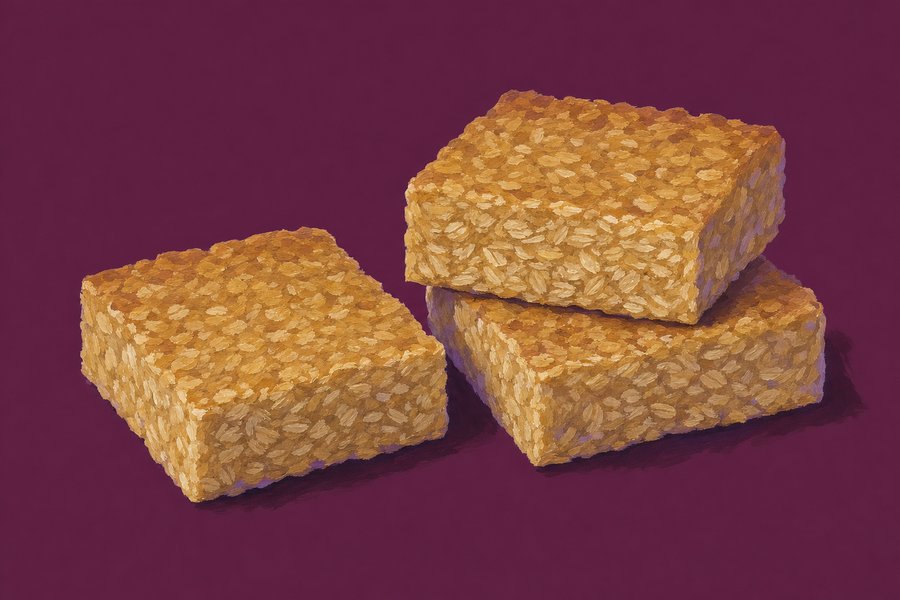
In the United Kingdom a flapjack is a baked bar: rolled oats bound with fat, sugar and usually golden syrup, cooked in a flat tin and cut into squares. It is a snack, nearer a granola bar than anything else, and it is eaten with tea rather than at breakfast.
In the United States, flapjack simply means pancake. The two words are interchangeable there. So a recipe found under the word may be for a tray of oats or for a griddle batter, and there is nothing in the name to tell them apart.
The clearest evidence that this is a genuine split rather than a quibble: the reference works do not treat it as one word with two uses. English Wikipedia carries two separate articles, “Flapjack” and “Flapjack (oat bar)”. The disambiguation is not this page’s invention.
No flour, and still not gluten-free
A British flapjack contains no flour. Oats, fat, sugar, syrup: there is nothing wheaten in the list, which leads reasonably enough to the assumption that it is safe for someone avoiding gluten. It is not, and the reason is not in the recipe.
Oats are routinely cross-contaminated in growing, harvesting, transport and milling, so ordinary oats cannot be relied on. Only oats sold specifically as gluten-free will do. This is a distinction the ingredient list actively hides: the label on the packet, not the recipe, is what answers the question.
It is the mirror image of the case at gluten-free crêpes, where a traditional French dish named after a wheat, blé noir or black wheat, contains none, while a dish named after buckwheat conventionally does.
The pancake words, in one table
Flapjack is not an isolated case. Three of the naming problems on this site belong to the same family of thin cakes in three languages, and one table settles all of them.
| Name | Where | What it is | Flour | Gluten-free |
|---|---|---|---|---|
| flapjack | United Kingdom | A baked bar of rolled oats bound with fat, sugar and usually golden syrup, cooked in a flat tin and cut into squares. | none - rolled oats | no |
| flapjack | United States | A pancake. The word is interchangeable with "pancake" in American use. | wheat | no |
| pancake | United Kingdom | A thin pancake with crisp edges, closer to a French crepe than to the thick American kind. | wheat | no |
| crepe (froment) | Brittany and generally | A thin wheat-flour pancake, fine and smooth-surfaced. | wheat (froment) | no |
| galette de sarrasin | Brittany | A buckwheat pancake, traditionally buckwheat flour, water and salt and nothing else, thicker and softer than a crepe with holes forming on the surface as it cooks and lacy edges. | buckwheat only (sarrasin, also called ble noir) | yes, traditionally |
| plaettar | Sweden and Finland | Small thin pancakes cooked in a plaettlagg, a cast-iron pan of shallow hollows. | wheat | no |
Only the members the sources support are listed. Note that “pancake” itself appears as a naming problem: the British one is thin with crisp edges, nearer a crêpe than the thick American kind, so the two words trade places in two directions at once.
Chewy or crisp: what is and is not established
The commonest request attached to this page asks for a chewy flapjack, which implies the alternative, a crisp or crumbly one, is a frequent and unwanted outcome. Two variables plausibly govern it: how much syrup is doing the binding, and how long the tray stays in the oven, since a flapjack that browns through dries as it cools.
That is reasoning rather than a source. Nothing consulted for this page specifies a ratio or a time that produces chewy against crisp, so no figures are given here. It is recorded as an open question rather than filled with numbers that would look authoritative and be invented, which is the same standard the rest of this site is held to.
Where it sits
The Swedish member of the thin-cake family, with its own regional naming problem, is at plättar. The site’s approach to quantities is set out at recipes, and the borrowed vocabulary is collected in the glossary.
Questions about flapjacks
Is a flapjack a pancake or an oat bar?
Both, depending on the country. In Britain it is a baked oat bar cut from a tin; in the United States the word means pancake. English Wikipedia keeps them as two separate articles, which is the clearest sign that it is a genuine split.
Are flapjacks gluten-free?
Not by default, even though they contain no flour. Oats are routinely cross-contaminated, so only oats sold specifically as gluten-free will do. The packet answers this, not the ingredient list.
What makes a flapjack chewy rather than crisp?
Not established here. The amount of syrup binding it and the length of the bake both plausibly matter, but nothing consulted for this page specifies a ratio or a time, so no figures are given rather than invented ones.
What is in a British flapjack?
Rolled oats, fat that is usually butter, brown sugar and usually golden syrup, baked in a flat tin and cut into squares. No flour.
Is a British pancake the same as an American one?
No, and this is a second naming problem stacked on the first. A British pancake is thin with crisp edges, closer to a French crêpe than to the thick American kind.