France has made a gluten-free crêpe all along
Brittany has two traditional pancakes, not one. The crêpe is wheat, or froment: fine, smooth-surfaced and sweet by convention. The galette is buckwheat, and in its traditional composition it is buckwheat flour, water and salt and nothing else: thicker, softer, holes forming on the surface as it cooks and lacy edges. In Upper Brittany the wheat one is the sweet one and the buckwheat one is eaten savoury, exclusively.
So the ordinary framing of this question, asking what you substitute for the flour, has an older answer than the question. The galette is not an adaptation. It predates the idea of a gluten-free diet by a very long way, and it qualifies without being modified.
The reason is botanical rather than culinary. Buckwheat is not a wheat and not a cereal: it is a Polygonaceae, a relative of sorrel and of rhubarb, which is already in this site’s fruit register. Its flour carries no gluten because it was never a grass in the first place.
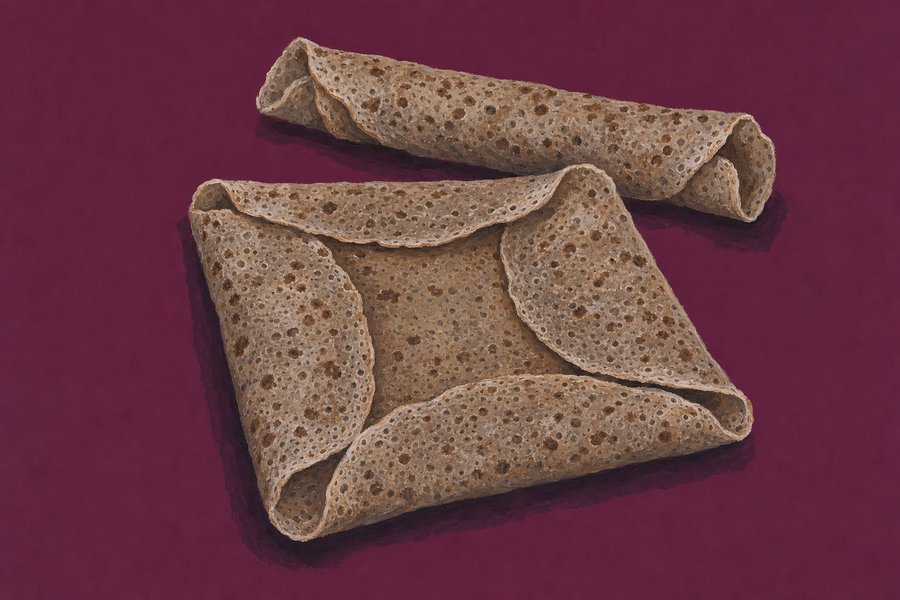
The trap, and it is the one that matters most
Two French names look like they should sort this out and do the opposite. A galette is traditionally buckwheat alone. A crêpe de sarrasin, a buckwheat crêpe named after the buckwheat, is conventionally a mixed batter: roughly sixty per cent buckwheat to thirty per cent wheat, plus eggs and sometimes milk.
So the dish named after buckwheat commonly contains wheat, and the dish not named after it commonly does not. For anyone avoiding gluten that is the single most useful sentence available on the subject, and it runs opposite to what the names suggest.
There is a second naming problem underneath it. Blé noir is the other French word for buckwheat, and it means black wheat. A name containing the word for wheat, on an ingredient that has no gluten in it, which is harmless once known and misleading until then.
None of which is a substitute for asking. A crêperie’s galette may or may not follow the traditional composition, and the naming conventions described here are conventions rather than rules. What this page can establish is which way round the names point; it cannot establish what is in a particular batter.
What buckwheat behaves like
A crêpe is among the easiest things to make without wheat, and the reason is structural. A thin pancake asks almost nothing of gluten: there is no crumb to hold open, no rise to support, no network needed to trap gas. The batter has to spread and set, and that is it. So the usual difficulty with gluten-free baking, the missing structure, barely applies.
What buckwheat brings instead is flavour: the traditional galette is described as rustic and slightly nutty, which is why it is eaten savoury rather than sweetened. That is a reason to choose it, not a compromise to accept.
Where it sits
This is one of three naming problems on this site belonging to the same family of thin cakes; the full table of them, including the flapjack that is a pancake in one country and a traybake in another, is at flapjack. The doughs and batters specified by ratio are collected in the technique section, and the French terms used across the site are in the glossary.
Questions about gluten free crêpes
Are Breton galettes gluten free?
In their traditional composition, yes: buckwheat flour, water and salt. Buckwheat is not a wheat or even a cereal but a Polygonaceae, a relative of sorrel and rhubarb, so its flour has no gluten.
Is a crêpe de sarrasin gluten free?
Usually not, and this is the trap. Despite being named after buckwheat, it is conventionally a mixed batter of roughly 60 per cent buckwheat to 30 per cent wheat, plus eggs. The galette, which is not named after buckwheat, is the one that traditionally has none.
Why is buckwheat called blé noir if it is not wheat?
Blé noir means black wheat, and the name is simply misleading. Buckwheat is not a cereal at all; the name records an appearance and a use rather than a botanical relationship.
What is the difference between a crêpe and a galette?
The flour, and by convention the filling. The crêpe is wheat, fine and smooth-surfaced, eaten sweet; the galette is buckwheat, thicker and softer with holes and lacy edges, and in Upper Brittany it is eaten savoury only.
Why are crêpes easier to make gluten free than bread?
Because a thin pancake asks almost nothing of gluten: no crumb to hold open, no rise to support, no network needed to trap gas. The batter only has to spread and set, so the usual difficulty of gluten-free baking barely applies.