They are the same word
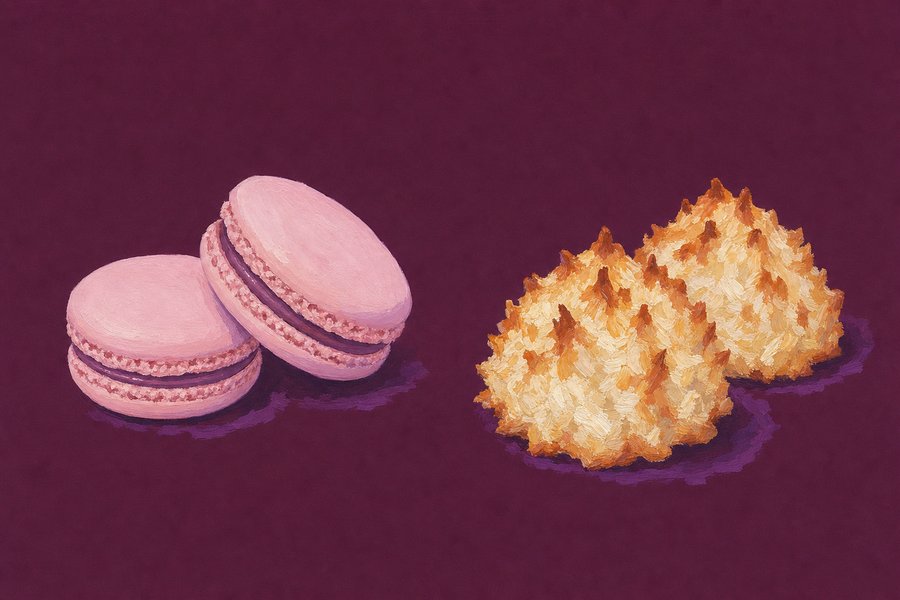
A macaron is two smooth-shelled almond-meringue discs sandwiched with a filling, each shell carrying a ruffled foot round its base. A macaroon, in English, is shredded coconut bound with egg white and granulated sugar: craggy, single, no foot.
They are usually presented as two things that get confused. The more interesting fact is that they are one word. English macaroon comes from French macaron, which comes from Italian maccarone. The spelling difference is not a corruption of one into the other; it is one word that ended up on two different biscuits.
What separated them was a product, not an error. When dried coconut became widely available in the nineteenth century, bakers swapped the almonds for coconut, which was sturdier and longer keeping, and the English word stayed with the coconut version.
Which is why the older usage is not wrong
The French spelling only became common in the United States around 2005. That single date explains a great deal of the argument: an older English speaker who calls the colourful almond sandwich a macaroon is not making a mistake, they are using the word the way English used it before the French form arrived. They are earlier, not wrong.
For anyone writing or reading recipes across the two, the reliable signals are physical rather than orthographic: almond flour and a smooth footed shell against shredded coconut and a craggy top. The spelling will not settle it, because for most of the word’s history it did not have to.
What the almond does, and what it does not need
A macaron shell is ground almond, egg white and icing sugar. There is no flour in it at all, which makes it naturally free of wheat, incidentally rather than by design, and worth knowing for the same reason the Breton galette is worth knowing.
The history is thinner than the etymology. The first almond-meringue biscuits are thought to have appeared in southern Italy, where almonds arrived with the Arabs in the eighth century, and almond macaroons became established in Italian-Jewish cookery because, being unleavened, they could be eaten at Passover. Where and when the biscuit first appeared is not established: the southern-Italian origin is reported as likely rather than documented.
Filling it with fruit
A fruit-filled macaron runs into the register’s subject from an unexpected direction. Peach is recorded there as low acid with low pectin and set group 3, the group that needs added pectin or acid to set at all, and it carries a lot of water. A loose, wet filling in a meringue shell softens it from the inside, which is why fruit macaron fillings are generally cooked down or set with something rather than used fresh. The peach entry, with its sources, is in the register; the rest of the technique material is in the technique section and the vocabulary in the glossary.
Questions about macarons
What is the difference between a macaron and a macaroon?
A macaron is almond, smooth-shelled, footed and sandwiched. A macaroon in English is shredded coconut bound with egg white and granulated sugar, craggy and single. But they are the same word: English macaroon comes from French macaron, from Italian maccarone.
Is it wrong to call a macaron a macaroon?
Not historically. The French spelling only became common in the United States around 2005, so older English usage applied macaroon to the almond biscuit too. That usage is earlier rather than incorrect.
Why did the two biscuits separate?
Because of coconut. When dried coconut became widely available in the nineteenth century, bakers swapped the almonds for it to get a sturdier biscuit that kept longer, and the English word stayed with the coconut version.
Do macarons contain flour?
No: ground almond, egg white and icing sugar. There is no wheat flour in a macaron shell at all, which makes it incidentally free of wheat rather than adapted to be.