What it is
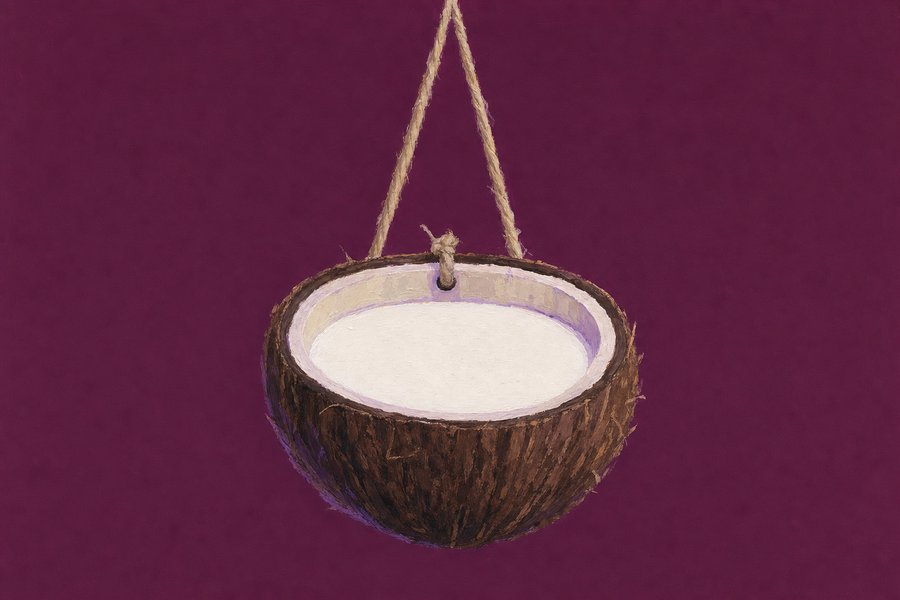
A halved coconut shell suspended on cord and filled with a set mixture of fat and seed. The shell is the container and, once emptied, birds work at the flesh still attached to it. Materials are a whole coconut, natural cord or macramé twine, a seed mix, and a hard fat as the binder.
Everything below the construction is a safety matter rather than a craft one, which is why this page is a specification rather than a set of steps. Getting the fat wrong is not a question of a feeder that works less well; it is a question of harming the birds.
The fat: hard and saturated only
Use hard saturated fat, meaning raw suet or lard. Birds need high levels of saturated fat, particularly in cold weather, which is why these feeders are also called suet cakes. A hard fat also holds the seed in a solid block that survives being pecked at, rather than crumbling away in the first hour.
Do not use polyunsaturated margarine or vegetable oils. They smear onto feathers and damage their waterproofing, which matters enormously to a small bird in winter, and they lack the saturated fat that made the feeder worth putting out.
Do not use bacon fat, or the fats and juices from cooking beef, chicken or turkey. Bacon fat is heavily salted. Roasting-tin fats can soil feathers, may be salty, and become a breeding ground for bacteria as they sit out. All of these get recommended in craft write-ups because they are free and to hand, and none of them should be used.
The fat must be pure and unsalted throughout. If peanut butter is used, it needs to be one with no added salt and no artificial sweeteners.
Hygiene, which is the part usually left out
Clean the shell in boiling water before refilling or reusing it. Disease spreads between birds at feeders that are not cleaned regularly, and a fat feeder is a worse offender than a seed feeder because the residue is greasy and holds onto everything.
The same logic argues for a feeder that empties reasonably fast. A shell that takes a month to clear has spent most of that month as a warm damp surface visited by a succession of birds, so sizing the fill to the traffic is a hygiene decision as much as a practical one.
Hanging it, and the shell itself
Natural cord is preferable to synthetic for a straightforward reason: it degrades rather than persisting, and loose synthetic cord is an entanglement risk. Macramé is the usual craft treatment because it distributes the load around the shell without needing a hole through the rim, which is the point where a drilled shell tends to split.
One figure this page will not give: a diameter. A coconut halves to something in the region of 10 to 12 cm across, but that is an impression rather than a measurement, and no source was found for it, so it is left out rather than asserted. Anyone who needs the figure should measure the coconut in front of them, which is in any case the only one that matters.
Placement deserves a thought as well. A feeder a couple of metres from a shrub gives small birds an escape route without giving a cat somewhere to wait, which is the usual compromise between cover and exposure. A feeder that swings also discourages the larger birds that would otherwise empty it, which is an argument for cord over a rigid bracket.
Safety figures on this page follow the Natural History Museum's guidance on fat balls for birds, Which? on feeding fats, and the RSPB East Berkshire group's notes on careful feeding. Those are the rows that can cause harm if wrong, which is why they are the rows that carry sources.
Questions about fat feeders
What fat should I use in a coconut bird feeder?
Hard saturated fat only, meaning raw suet or lard. Birds need saturated fat, and a hard fat holds the seed in a block that survives being pecked rather than crumbling away.
Can I use margarine or vegetable oil?
No. Polyunsaturated margarines and vegetable oils smear onto feathers and damage their waterproofing, which is dangerous for a small bird in cold weather, and they lack the saturated fat that makes the feeder useful.
Can I use leftover bacon or roasting fat?
No. Bacon fat is heavily salted, and fats and juices from beef, chicken or turkey can soil feathers, may be salty, and become a breeding ground for bacteria as they stand.
Does the shell need cleaning between fills?
Yes, in boiling water. Disease spreads between birds at feeders that are not cleaned regularly, and greasy fat residue holds contamination better than seed does.
Is peanut butter safe?
Only if it has no added salt and no artificial sweeteners. Read the label; many supermarket brands are salted.