What is a canelé?
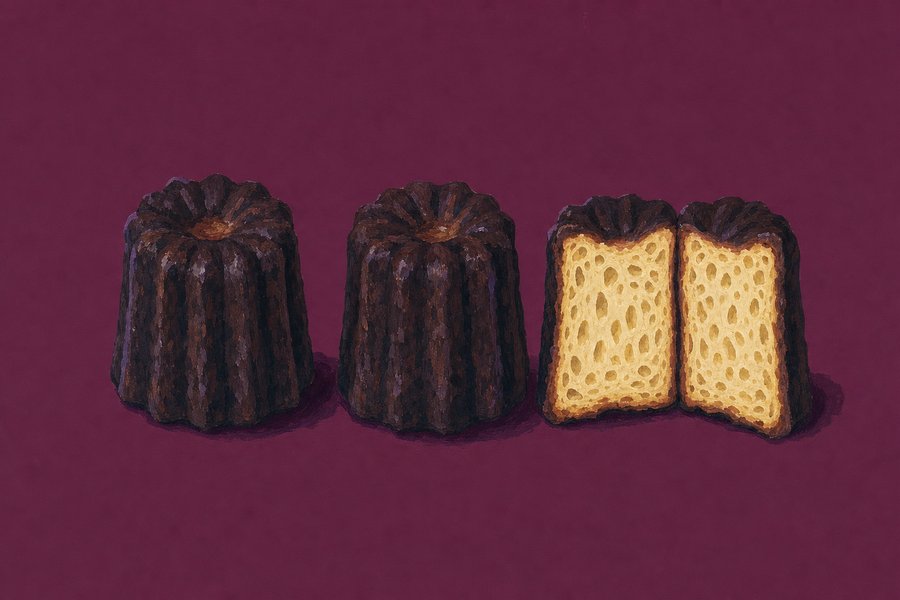
A canelé is a small fluted cake with a dark, almost burnt, crisp shell and a soft custardy inside, flavoured with rum and vanilla. The batter is thin and egg-rich, closer to a custard than to a cake batter, and the contrast between the outside and the inside is the whole of what it is judged on.
Two things produce that contrast, and neither is an ingredient. The mould is individual, fluted and made of copper, valued for how readily it conducts heat, and it is traditionally brushed with beeswax. As beeswax became expensive, mixtures of beeswax and butter came into use. The wax is what allows the outside to set hard and dark while the middle stays loose.
Which is why a canelé baked in a silicone mould is a different object with the same recipe. The equipment is not an accessory here; it is part of the specification.
One n or two: the answer is a trademark, not a preference
The question behind most searches here is how the word is spelled, and it has a datable answer. The second n was dropped in 1985, and the single-n form was registered as a collective brand with INPI, the French national industrial-property institute. So canelé is not the preferred spelling; it is the registered one.
What that does and does not mean is worth being precise about, because it is often described as being “like an AOC”. It is not. An appellation of origin governs where a thing may be made and how; a collective brand governs who may use a name. The registration is about the word.
And it is not universally followed. Parisian houses including Ladurée and Pierre Hermé still write cannelé with two ns. Anyone who has seen both spellings on shop windows has seen the registration and the practice diverge.
Two further claims circulate in the trade and are recorded here as claims. Bordeaux pâtisserie houses say the Confrérie du Canelé de Bordeaux was founded in 1985 by 88 pâtissiers, and that the Académie française prescribes the double-n spelling. The 1985 founding is corroborated; the membership figure and the Académie assertion are not covered by the better source consulted, and these houses have a commercial interest in the authenticity claim they are describing. Neither is stated here as fact.
The origin is not settled, and the dates that are firm are the later ones
The canelé is believed to originate at the Couvent des Annonciades in Bordeaux, in either the fifteenth or the eighteenth century. That is not a rounding: the account that reports both marks the date as uncertain, and a three-hundred-year spread is the honest state of it. A possible predecessor, the canole, is traced to Limoges.
What is dated: professional canauliers registered a guild in 1663, and the modern form reappeared in the early twentieth century when an unnamed pâtissier revived the old recipe and added rum and vanilla. Who that was is not established.
The scale after the registration is documented and striking. Ten years on there were at least 800 makers in Aquitaine and 600 in the Gironde; by 1992 the Gironde alone was eating some 4.5 million canelés a year. A protected name and a regional industry arrived together.
Where it sits
The canelé is the clearest case on this site of a bake whose name is legally governed, and it is not the only one: the word boulangerie is protected in French law in a stricter way, governing what a business may call itself rather than what a cake may be called. The doughs, creams and specifications are collected in the technique section, and the French vocabulary this site borrows is in the glossary.
Questions about canelés
Is it canelé or cannelé?
Canelé, with one n, is the registered form: the second n was dropped in 1985 and the single-n name was registered as a collective brand with INPI, the French industrial-property institute. Parisian houses including Ladurée and Pierre Hermé still use two, so both spellings are in circulation.
Is canelé a protected designation of origin?
No, and the distinction matters. It is a collective BRAND, which governs who may use the name. An appellation of origin would govern where the thing may be made and how; this registration is about the word.
Why are the moulds copper, and why beeswax?
Copper for its heat conduction, beeswax brushed inside so the shell sets hard and dark while the middle stays loose. As beeswax became expensive, beeswax-and-butter mixtures came into use. The mould is part of the specification rather than an accessory.
How old is the canelé?
Not settled. It is believed to originate at the Couvent des Annonciades in Bordeaux in either the fifteenth or the eighteenth century, and the source reporting both marks the date as uncertain. What is dated is a canauliers guild in 1663 and the 1985 registration.
Who invented the modern canelé?
Not established. The modern form reappeared in the early twentieth century when an unnamed pâtissier revived the older recipe and added rum and vanilla; no source consulted names them.