What is a kladdkaka?
A kladdkaka is a dense, low-flour chocolate cake taken out of the oven deliberately short of set, so that the middle stays soft and sticky while the edge holds. Kladd is the sticky part of the name; it is describing the texture, and the texture is the point rather than a tolerated side effect.
Which makes it unusual among the cakes on this site. Everything else here is defined by a ratio or a composition: how much sugar against how much butter, what binds it, what sets it. A kladdkaka is defined by when it leaves the oven. Bake it until a skewer comes out clean and it is no longer a kladdkaka; it is a plain, rather dry chocolate cake. The judgement is the recipe.
The usual comparison is a brownie, and it is a reasonable one for texture. Where the accounts of its origin differ is on whether that resemblance is a coincidence or a descent, and that turns out not to be settled.
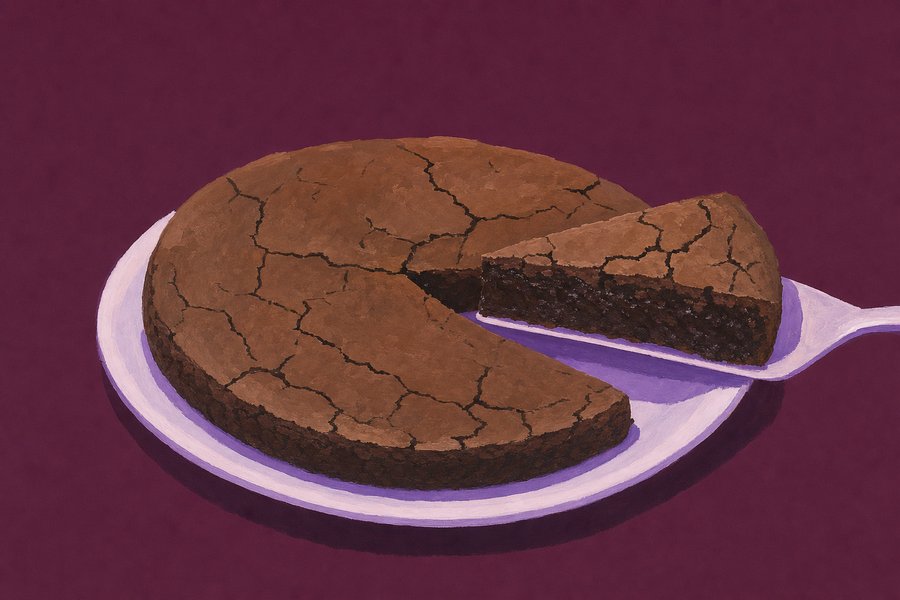
The origin is disputed, and both claims are worth knowing
Two accounts circulate, each with a name attached. One places it in Örebro in 1938, with Gudrun Isaksson working from an American brownie recipe and leaving out the baking powder because it was hard to get. On that telling, the kladdkaka is a brownie with an ingredient missing, and the missing ingredient is precisely what makes it dense. The other places it in 1968, with Margareta Wickman given a chocolate cake recipe at a Paris restaurant and publishing variants of it afterwards.
Neither is corroborated by anything that dates it independently, so this page does not choose between them. What is documented rather than claimed is later: recipes for it appear in Swedish cookbooks and magazines from the mid-to-late 1970s, and the Swedish chef Magnus Nilsson describes it as a recent addition to Swedish cake culture whose origins are unclear.
That gap, between a claimed 1938 or 1968 and a documented 1970s, is the honest state of it. A cake that feels like an old national dish is, on the evidence available here, about fifty years old in print.
The one thing to know about the batter
Because the cake is meant to come out underbaked, it attracts advice about tasting the batter and about making flour safe to eat raw. The first is a real risk and the second is wrong.
The US Food and Drug Administration states that most flour is a raw food: it has not been treated to kill the bacteria that cause food poisoning, and outbreaks of E. coli and Salmonella have been traced to raw flour and raw dough. So uncooked batter is not something to taste, which is the ordinary and easily-followed part.
The part that contradicts a great deal of published advice is the remedy. The FDA advises specifically against heat-treating flour at home, on the grounds that a home treatment may not kill everything and does not make the flour safe to eat raw. Recipes and baking sites routinely recommend microwaving or oven-drying flour for exactly this purpose. The agency’s position is that it does not achieve what it is being recommended for.
None of which is a statement about the finished cake. A kladdkaka is baked; the risk described above belongs to the batter, and nothing consulted here says otherwise about the cake that comes out. The distinction is worth keeping precisely because it is the kind that gets flattened in the retelling.
Where it sits
Starch cooked in liquid until it thickens is the mechanism behind a surprising amount of this site. It is what sets a pastry cream, and it is what a water-roux does to an enriched dough. A kladdkaka is the opposite case: a cake with very little flour in it, stopped before the little it has can do much. The rest of the Swedish bakes are indexed in the Nordic section, and the weight-first approach the rest of the site takes to quantities is set out at recipes.
Further reading on the raw-flour and raw-egg question: the Partnership for Food Safety Education.
Questions about kladdkaka
Is a kladdkaka meant to be underbaked?
Yes. The soft, sticky middle is the definition rather than a fault. Baked until a skewer comes out clean it is no longer a kladdkaka but a dry chocolate cake.
What is the difference between a kladdkaka and a brownie?
Texturally they are close, and one of the two origin stories has the kladdkaka as a brownie recipe with the baking powder left out. Whether that is the actual descent is not established, because the accounts conflict and neither is independently dated.
Where does kladdkaka come from?
Not settled. One account names Gudrun Isaksson in Örebro in 1938, another Margareta Wickman and a Paris restaurant recipe in 1968. What is documented rather than claimed is that recipes appear in Swedish print from the mid-to-late 1970s.
Is it safe to taste kladdkaka batter?
No. The FDA states that most flour is raw and untreated, and that outbreaks of E. coli and Salmonella have been traced to raw flour and raw dough. The risk is in the batter, not in the baked cake.
Should flour be heat-treated at home to make batter safe?
The FDA advises against it: a home treatment may not kill everything and does not make flour safe to eat raw. This is worth stating because the opposite advice, microwaving or oven-drying flour, is commonly published.