What is a kanelbulle?
A kanelbulle is an enriched wheat bun of flour, milk, yeast, sugar, butter and, in the Swedish version, usually cardamom, rolled up with a filling of butter, sugar and cinnamon. It is commonly finished with pearl sugar, and sometimes with flaked almond. The plural is kanelbullar.
The detail worth stating first is where the cardamom goes. It is in the dough, not the filling. Cinnamon is the filling; cardamom is the background the bun is built on, which is why a kanelbulle does not taste like a cinnamon roll made to an American recipe even when the filling is identical. Leave the cardamom out and the result is recognisably a different bun.
The pearl sugar on top is not ordinary granulated sugar. It is the same coarse sugar that finishes a French chouquette, called sucre en grains there and pearl sugar here, and it is chosen because it survives the oven instead of dissolving into the crust. Two traditions, one ingredient, for the same reason.
Where Kanelbullens dag came from
Kanelbullens dag falls on 4 October, and unlike most food days it has a traceable beginning. It was instituted in 1999, timed to the fortieth anniversary of Hembakningsrådet, the Home Baking Council, historically an association of producers of yeast, flour, sugar and margarine. The date, the organisation and the anniversary all come from the day’s own record, which makes them about as firm as a claim of this kind gets.
Two further details are worth having but sit on weaker ground, and the difference matters. Swedish Wikipedia names Kaeth Gardestedt, then the council’s project manager, as the originator, and reports that October was chosen so the day would not compete with the other Swedish autumn traditions of apple festivals, goose dinners, crayfish and surströmming. The day’s own record gives neither of those, so they are repeated here as secondary rather than treated as established.
What the day is for is less ambiguous: it was set up to draw attention to home baking, by an organisation of the people who sell what home baking uses. That is not a criticism, and it explains the choice of the bun, because the kanelbulle is the thing most Swedish households already bake.
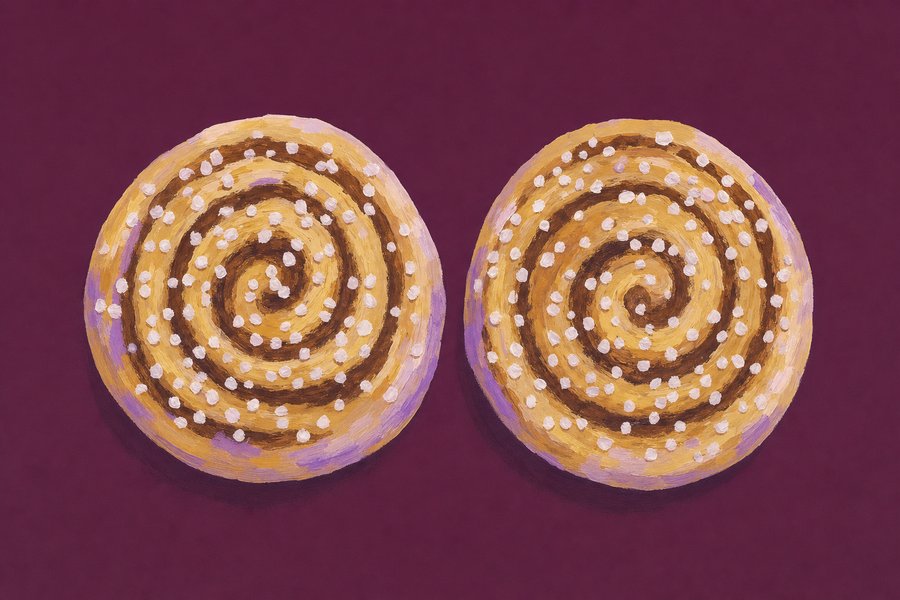
Korvapuusti is not a different recipe. It is a different cut
The Finnish version, korvapuusti, is made from the same enriched cardamom dough with the same cinnamon-and-sugar filling. What differs is the knife. Where a Swedish kanelbulle is cut straight across the rolled log into a spiral, a korvapuusti is cut on the slant and then pressed down through the middle, which forces the layers out at both ends.
The name says exactly that. Korvapuusti means, roughly, a slap on the ear, and the Swedish name for the same shape, örfil, means the same thing. Neither name describes a flavour or an origin; both describe what the finished bun looks like. So anyone comparing a kanelbulle with a korvapuusti on their ingredient lists is comparing the wrong thing, and anyone looking for the difference will find it in the shaping step or not at all.
A third form belongs in the same list: the kanelknut, where the dough is cut into strips and tied rather than coiled. Three shapes, one preparation. What has never been dated here is when any of the three shapes appeared, or whether the slant cut precedes the spiral; the naming is well attested in ordinary use and nothing consulted places it in time, so that stays not established.
Where it sits
A kanelbulle is year-round baking rather than seasonal, which separates it from the Christmas set. The one Swedish bun that is seasonal, and the one where the spice is doing something measurable rather than aromatic, is the saffron bun, where the dosage question is handled at baking with saffron. The rest of the Nordic bakes are indexed in the Nordic section, and the Swedish and French vocabulary this site borrows is collected in the glossary.
Questions about kanelbullar
When is Kanelbullens dag?
4 October. It was instituted in 1999, timed to the fortieth anniversary of Hembakningsrådet, the Swedish home-baking council, and that much comes from the day’s own record rather than from repetition.
What is the difference between a kanelbulle and a korvapuusti?
The cut, not the recipe. Both are the same enriched cardamom dough with the same cinnamon filling; a kanelbulle is cut straight across into a spiral, a korvapuusti is cut on the slant and pressed through the middle so the layers splay at both ends.
What does korvapuusti mean?
Roughly, a slap on the ear, describing the shape rather than the flavour. The Swedish name for the same form, örfil, means the same thing.
Why is there cardamom in a cinnamon bun?
Because it is in the dough rather than the filling. Cinnamon is what is rolled into it; cardamom is the base the bun is built on, and it is the main reason a kanelbulle does not taste like a cinnamon roll made to an American recipe.
Can ordinary sugar replace the pearl sugar on top?
Not for the same effect. Pearl sugar is coarse enough to survive the oven instead of dissolving into the crust, which is exactly why French choux buns use the same ingredient under the name sucre en grains.