Gelée is a result, not a technique
The word gelée describes what something ends up as: clear, set, holding its shape. It does not say what made it do that. A fruit gelée sets on pectin. A meat gelée sets on gelatin from bone. A gelée made with agar sets on a seaweed extract. They share an outcome and nothing else.
Which makes this the one page on the site where the setting mechanism cannot be read off the name or the ingredients. There is no fruit in an olive oil gelée, so there is no pectin and no fruit acid; the set is entirely supplied. What supplies it has to be asked every time.
It belongs, in other words, to the setting-agent side of preserving rather than to the fruit side that the register measures.
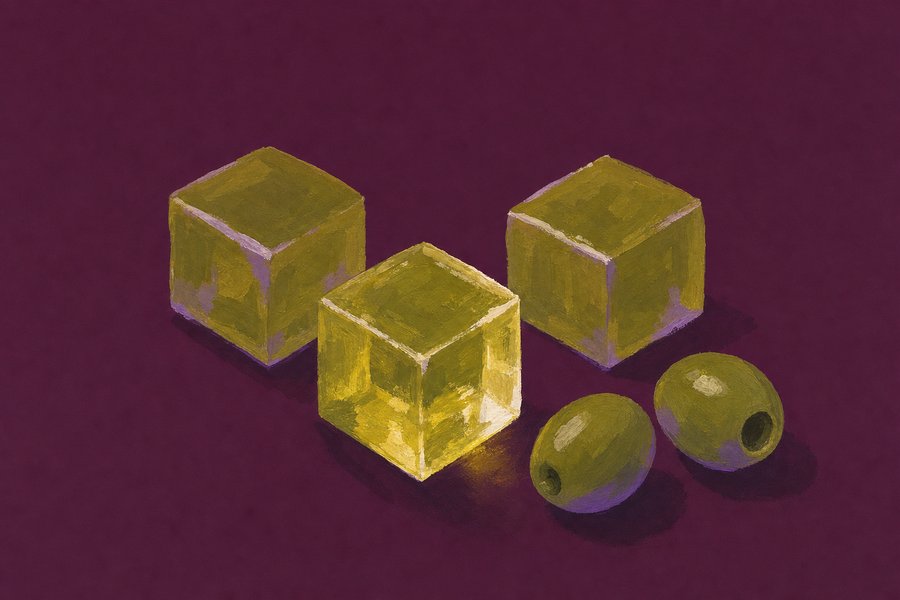
The ambiguity, and it is a large one
Search for this phrase and most of what comes back is not gelling olive oil. It is gelling an aqueous preparation with agar and using chilled olive oil as the bath the drops set in, the technique that produces small spheres, sometimes called agar caviar or pearls. The oil is the coolant. It is not the thing being set.
There is a straightforward reason those two get confused and a straightforward reason they are different. Agar is a hydrocolloid: it hydrates in water and gels as that water cools. It cannot set a fat, because there is no water in a fat for it to work with. So a recipe that says agar and olive oil in the same breath is almost always describing the bath rather than the subject.
Whether a genuine gelled olive oil, the oil itself made solid, is what the phrase is meant to name is not established here. No sourced method for doing it was found, and none is asserted. Structuring a fat into a solid is a real category of technique, but this page does not have a source for it and will not invent one.
Where it sits among the sets
This site now specifies five ways a thing can be made to hold together, and it is worth having them in one place, because knowing which one is at work is what tells you how to fix a failure:
Pectin, with acid and sugar, sets a jam, the whole subject of the register. Starch, gelatinised by cooking, sets a pastry cream. Egg protein, coagulating, sets a curd. Fat, recrystallising as it cools, sets a ganache. And a hydrocolloid such as agar sets whatever water it is dispersed in, which is the case here.
Only two of those five are reversible by reheating, and only the fat sets by cooling alone. That is the practical value of keeping them distinct. The terms are collected in the glossary.
Questions about olive oil gelée
Can agar set olive oil?
No. Agar is a hydrocolloid: it hydrates in water and gels as that water cools, so it has nothing to work with in a fat. A recipe pairing agar with olive oil is almost always using the oil as a cold setting bath rather than gelling it.
What does gelée mean?
A result rather than a method: clear, set, holding its shape. A fruit gelée sets on pectin, a meat one on gelatin, an agar one on seaweed extract. The word says nothing about which.
How much agar per litre?
8 to 10 g per litre of preparation, or about 2 g per 500 ml. It has to be brought to the boil, around 90 °C for one to two minutes, to hydrate, and it gels as it falls back through about 40 °C.
Is there pectin in an olive oil gelée?
No. There is no fruit in it, so no pectin and no fruit acid. The set is entirely supplied by whatever agent is added.