Coulis meaning, and the three it is confused with
A thin uncooked or barely cooked fruit puree, strained smooth and used as a sauce. The two words that matter in that definition are strained and barely cooked: a coulis is smooth because the seeds and fibre have been passed out of it, and it is fresh-tasting because it has had little or no heat.
- Coulis — A thin uncooked or barely cooked fruit puree, strained smooth and used as a sauce.
- Compote — Fruit cooked gently in syrup, keeping recognisable pieces.
- Purée — fruit blended smooth, unstrained, so fibre and seed remain.
- Confiture — French for jam. Cooked with sugar until it sets.
The distinctions are decisions rather than gradations. Straining separates coulis from purée. Keeping the pieces intact separates compote from both. And the pectin, acid and sugar gel that sets a jam separates it from all three. A cooked, strained, set fruit sauce is a jam; the same fruit strained and not set is a coulis.
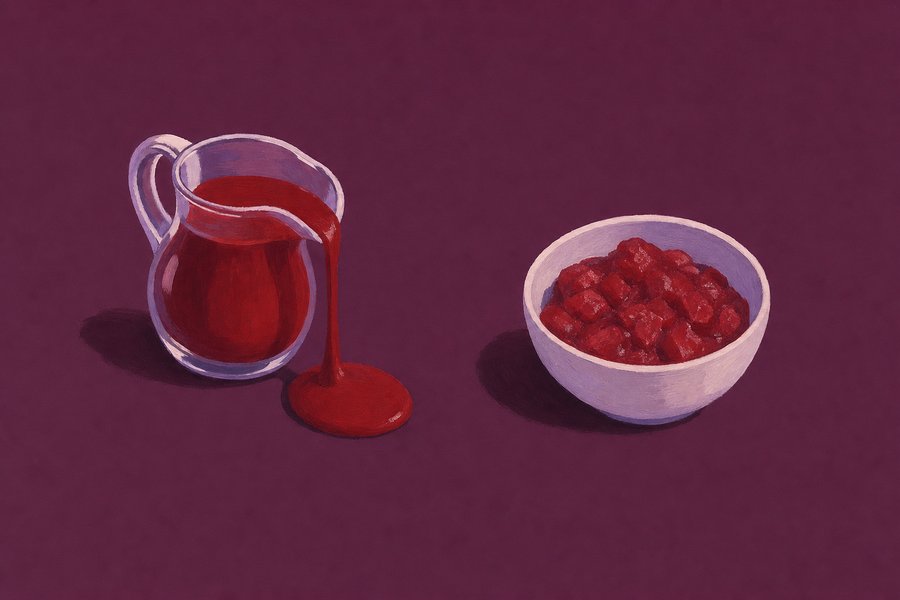
Why a coulis is not cooked much
Heat costs a fruit sauce its fresh aroma, and a coulis exists to deliver that aroma. Volatile compounds are driven off by prolonged cooking, which is why a cooked raspberry sauce tastes of cooked raspberry rather than of raspberry, which is a different and perfectly good thing but not what a coulis is for.
The consequence is that a coulis is thin, and it is meant to be. It carries no set and little reduction, so it pools rather than coats. Thickening one with starch or reducing it hard turns it into something else; if a thicker sauce is wanted, the honest answer is to use a purée or a lightly set fruit sauce rather than to force a coulis to behave like one.
Sugar in a coulis is for balance rather than for structure, which is the opposite of its role in a jam. That means the quantity is a matter of taste and of the fruit, and it can be adjusted at the end, unlike in a preserve, where sugar is doing structural work and cannot be reduced freely.
Which fruits suit which preparation
Fruit choice follows from the same properties that decide a set. A fruit with a lot of seed or fibre, such as raspberry, blackcurrant or fig, gains most from being strained, so it makes a better coulis than purée. A fruit that holds its shape when cooked gently makes a good compote; one that collapses to liquid does not, which is why rhubarb at 93.6% water makes a poor compote and a good sauce.
Keeping is the other practical difference between the four, and it follows from the same logic. A jam keeps for months because sugar and acid together make it inhospitable; a compote keeps for days because it is cooked but not preserved; a coulis keeps for a day or two at most because it has neither been reduced nor set. A coulis is made close to when it is eaten, or frozen, and freezing suits it well since there is no gel structure for ice crystals to damage.
Straining is worth a note of its own. A chinois, the conical strainer, is the tool for it, and the point is to press rather than to let it drip: a coulis left to drain gives a thin, pale liquid, while one pushed through with a ladle carries the pulp that gives it body and colour.
And a fruit short of pectin or acid, which will not set into a jam, may be the best candidate for a coulis precisely because nothing is being asked of its gelling. Fig is the standard example: awkward as a preserve, straightforward as a sauce. The per-fruit figures are in the register, and the setting mechanism is in the preserves section.
Questions about fruit sauces
What is a coulis?
A thin fruit purée, uncooked or barely cooked, strained smooth and used as a sauce. Strained and barely cooked are the two defining properties.
What is the difference between a coulis and a compote?
A coulis is strained smooth and thin; a compote is fruit cooked gently in syrup with the pieces kept recognisable. One is poured, the other spooned.
What is the difference between a coulis and a purée?
Straining. A purée is blended smooth but keeps its fibre and seed; a coulis has been passed through a sieve or a conical strainer to remove them.
Can I thicken a coulis?
You can, but it stops being one. A coulis is thin by design because it carries no set and little reduction. If a thicker sauce is wanted, use a purée or a lightly set fruit sauce instead of forcing this one.
Which fruits make the best coulis?
Seedy and fibrous ones, which gain most from straining, such as raspberry, blackcurrant and fig, and fruits that will not set into a jam anyway, since nothing is being asked of their pectin.