Two things under one word
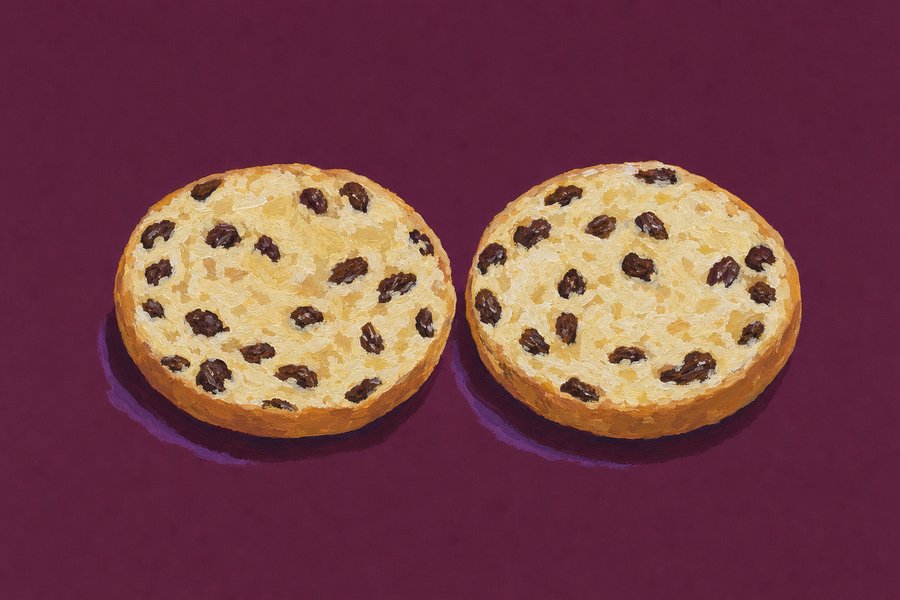
In most of England a teacake is a light, sweet, yeast-raised bun containing dried fruit, usually currants, sultanas or candied peel, split, toasted and buttered, and eaten with tea. The Yorkshire form of that is described as round, slightly flattened, enriched and soft, with a little sugar, spice, dried fruit and peel.
In West Yorkshire a teacake is a plain bread roll. Not a less sweet bun: an unsweetened roll, and often a large one, up to around 225 mm, nine inches, across, used to make very large sandwiches.
So this is not a regional preference about how much fruit goes in. It is a word that names a sweet baked good in one place and a sandwich roll a county away.
The compound that proves the problem
The strongest evidence that the bare word is unreliable is not an argument, it is a phrase. In East Lancashire, parts of Yorkshire and Cumbria, people say currant teacake, and they say it precisely to distinguish the fruited kind from the plain roll.
A language does not evolve a disambiguating compound for a distinction nobody has to make. Its existence is a record of the ambiguity being a practical nuisance for the people living with it, which is a more convincing demonstration than any dictionary entry.
It is the same shape of evidence as the two separate encyclopaedia articles for the two senses of flapjack. In both cases the reference works and the everyday vocabulary have already conceded the split.
Which one an almond-and-raisin version is
A teacake with almonds and raisins in it is unambiguously in the sweet family, and the raisins place it with the currant kind rather than with the West Yorkshire roll. But it is worth noticing that a fruited loaf is yet another thing under a similar name. A tea loaf is a fruited loaf cake, not a split-and-toasted bun, so the format matters as much as the fruit.
Where the almonds sit is a question this page cannot answer from a source. Whether they are conventionally in the dough, on top, or both is not established here, and no quantities are given. What the page can settle is which family the thing belongs to and why the name alone will not tell anyone.
Where it sits
This is the third naming problem in the British set on this site, after the flapjack that is a pancake in America and the biscuit that is a savoury bread roll there. The one dough here with a stated ratio is shortbread, and a second terminology page in the same family, a French word for an English loaf, is at cake banane. The terms are collected in the glossary.
Questions about teacakes
What is a teacake?
In most of England, a light sweet yeast bun with dried fruit, whether currants, sultanas or peel, split, toasted and buttered. In West Yorkshire it is a plain bread roll, which is a different food rather than a variation.
Why do some people say currant teacake?
To disambiguate. In East Lancashire, parts of Yorkshire and Cumbria the compound exists precisely to tell the fruited kind from the plain roll, which is good evidence that the bare word does not settle it.
How big is a West Yorkshire teacake?
Reported as up to about 225 mm, roughly nine inches, across, so large enough to be used for very large sandwiches.
Is a tea loaf the same as a teacake?
No. A tea loaf is a fruited loaf cake rather than a split-and-toasted bun, so the format differs even where the fruit is similar.