Scones meaning, precisely
The scones meaning that matters is structural: A small British quick bread, raised with baking powder rather than yeast, usually round and roughly 5-6 cm across, split horizontally to serve.
The defining feature is the raising agent. A scone is a quick bread, so it uses baking powder or bicarbonate rather than yeast, so there is no proving and the whole thing is made and baked inside half an hour. That single fact separates it from every enriched yeast bun it resembles, and it is why a scone must be handled quickly and baked immediately once the liquid goes in.
What does a scone look like?
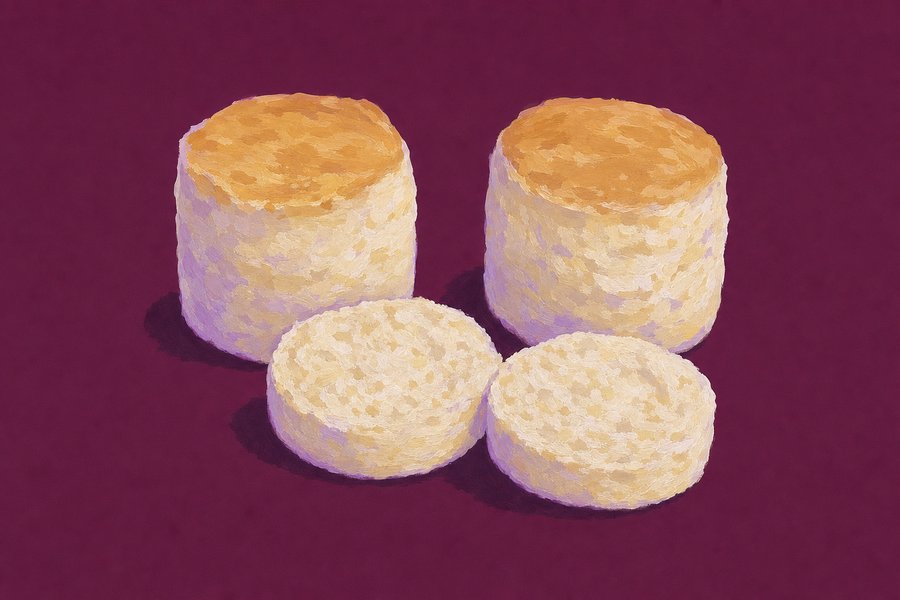
Answering what does a scone look like with a picture in words: round, roughly 5 to 6 cm across, and noticeably tall for its width, deep enough to split horizontally into two halves. The top is pale gold rather than browned, often glazed with egg or milk, and the sides are usually paler still and slightly ragged where the rise tore them.
That ragged side is the mark people look for and it is worth explaining, because it is the visible evidence of a good scone. The dough is cut rather than shaped, and it rises fast enough that the cut edge splits as it goes up. A scone with smooth, even sides has generally been over-handled, which develops gluten and holds the rise down. A scone that is wider than it is deep has usually had too much liquid, or been rolled too thin.
Shape is regional rather than fixed. Round cut with a plain cutter is standard in England; triangular wedges cut from a flattened round are common in Scotland and in North America. A fluted cutter is a matter of preference, though a plain one is often said to give a better rise because it does not pinch the edge.
Scone, biscuit, rock cake: what is what
The closest relative is the American biscuit, and functionally they are the same idea: a chemically raised quick bread, split and eaten with something. The differences are that a scone is normally lightly sweetened and a biscuit is not, and that a biscuit is usually served with savoury food. A British biscuit is an entirely different object, what Americans call a cookie, and one of the reliable sources of confusion between the two vocabularies.
A rock cake is a rougher, sweeter, drier thing with dried fruit, dropped in spoonfuls rather than cut, and not split. A Welsh cake is cooked on a griddle rather than baked. A bannock is the larger single round from which the wedge shape descends. All are quick breads; the differences are in shaping and in fat.
The pronunciation, since it always comes up
There are two pronunciations in general use in Britain, rhyming with “gone” and rhyming with “cone”, and neither is incorrect. The distribution is partly regional and partly a class marker, and it maps unreliably onto both. Anyone confident that one is right is describing their own region rather than the language.
The other argument, whether cream or jam goes on first, is likewise a regional convention rather than a rule: the Devon and Cornwall orders are opposite and each is standard where it is standard. Both arguments are older than any of the participants and neither has a resolution.
One more structural point, because it explains most disappointing scones. The fat has to stay in pieces rather than being rubbed in completely: visible flecks of butter turn to steam in the oven and are part of what lifts the scone. A dough rubbed to an even crumb has lost that mechanism and relies on the baking powder alone, which is why it rises less and eats denser. The same logic is why the liquid goes in all at once and is barely mixed.
Related terms are collected in the glossary, and the general question of why these recipes are given by weight is covered in the recipes section.
Questions about scones
What is a scone?
A small British quick bread raised with baking powder rather than yeast, usually round, roughly 5 to 6 cm across, and split horizontally to serve. No proving is involved, which is what separates it from an enriched yeast bun.
What does a scone look like?
Round and tall for its width, deep enough to split in two. Pale gold on top, paler at the sides, with a ragged split edge where the fast rise tore it. Smooth even sides usually mean the dough was over-handled.
Is a scone the same as an American biscuit?
Functionally yes, since both are chemically raised quick breads, split and eaten with something. A scone is usually lightly sweetened and a biscuit is not, and a biscuit is normally served with savoury food. A British biscuit is a different thing entirely: a cookie.
Why did my scones come out flat?
Usually over-handling, which develops gluten and holds the rise down, or too much liquid, or rolling the dough too thin. Scones want to be mixed as little as possible and baked immediately.
How is scone pronounced?
Both ways are in general use in Britain, rhyming with “gone” and rhyming with “cone”, and neither is incorrect. The split is partly regional and partly social, and maps reliably onto neither.