What is a tarte tropézienne?
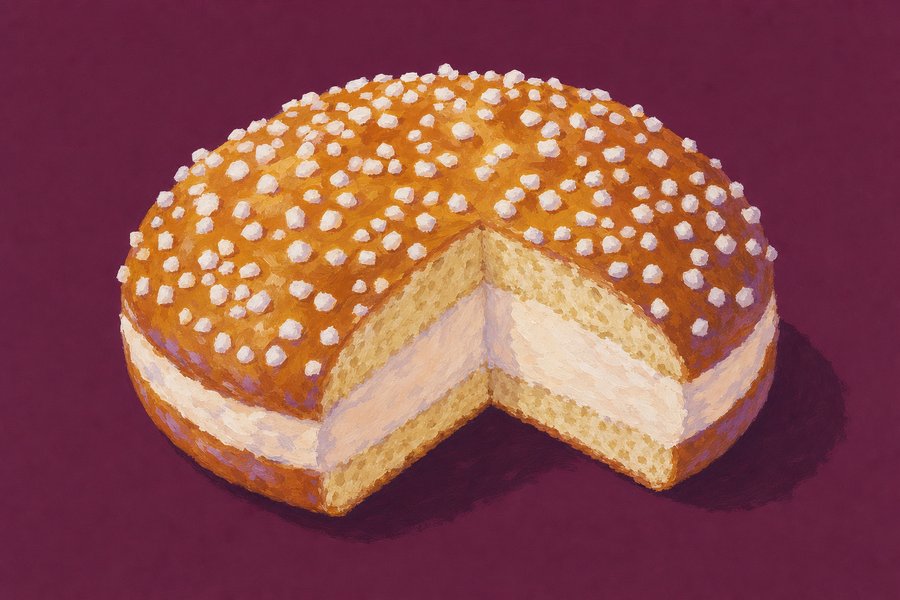
A halved brioche topped with pearl sugar, filled with a mix of TWO creams - a thick creme patissiere plus buttercream. It is not a tart in any structural sense, because there is no pastry case. It is a brioche split horizontally, the way a scone or a Victoria sandwich is split, and filled.
Its origin is Saint-Tropez, French Riviera, and it dates to 1952, by the Polish confectioner Alexandre Micka, adapting a family recipe. The name came later: Brigitte Bardot suggested it in the mid-1950s while filming in Saint-Tropez, and it was adopted. The same dessert became popular in Prague in the 1970s, where it is known as Prague cake.
One point of care. The name was registered as a trademark in 1973 and the original business still trades, so this page describes the pastry generically and implies no association with that company. The pastry is widely made under the name across France; the shop is a separate thing from the thing.
Why two creams
The filling is the part worth understanding, because a combination is unusual and it is not arbitrary. It pairs a thick crème pâtissière with a buttercream, and each contributes something the other cannot.
Crème pâtissière is set with starch. It is thick and holds its shape, but it is also relatively light and it weeps if it is over-worked or left too long. Buttercream is set by fat firming as it chills. It is stable and carries weight, but on its own it is heavy and cloying in the quantity this dessert needs.
Combined, the pastry cream brings the flavour and the lightness and the buttercream brings the structure, which matters here because the filling has to support a lid of brioche without being squeezed out at the edges when the thing is cut. A single cream would either collapse under the top or be too dense to eat in that depth.
The combination has a name of its own when the proportions favour the pastry cream: crème mousseline, which is pastry cream with softened butter beaten in. Whether a given tropézienne filling is properly a mousseline or a pâtissière-plus-buttercream is a question of ratio and of how the two were combined. The whole family is set out at the pastry creams.
The brioche, and the pearl sugar
The base is an enriched brioche rather than a cake, which is why it splits cleanly and why it stales quickly, so a tropézienne is a same-day or next-day dessert. Enriched dough behaviour is covered at brioche.
The pearl sugar on top is not decoration. It is a coarse compressed sugar that resists melting, so it stays as visible white grains on the crust and gives the crunch that contrasts with the cream. Granulated sugar in its place dissolves into the crust and contributes nothing; icing sugar burns. Where pearl sugar is unavailable, leaving it off is closer to the original than substituting.
A word on the split, since it is the step most likely to go wrong. The brioche has to be cold and fully cooled before it is cut, and cut with a long serrated blade in a single sawing pass rather than pressed through. A warm brioche compresses under the knife and the two halves come apart unevenly, which shows in the finished dessert because the lid no longer sits flat.
Size is part of the identity. The classic form is a single large round cut into wedges at the table, and the individual portion-sized version is a later convenience. The large format is not merely traditional: a wide shallow disc of brioche carries a deep filling better than a small one, because the lid spans a proportionally shorter distance relative to its own thickness.
A last structural note. Because the filling is soft and the lid is bread, the dessert is assembled cold and served cold, and it does not travel well. That is a property of the construction rather than a fussiness, because a warm tropézienne is a plate of brioche and cream.
Questions about the tropézienne
What is a tarte tropézienne?
A halved brioche topped with pearl sugar and filled with two creams: a thick crème pâtissière combined with buttercream. It comes from Saint-Tropez and dates to 1952.
Why is it called a tart if there is no pastry?
The name is conventional rather than descriptive. Structurally it is a split enriched bread with a filling, closer to a filled brioche than to anything in a pastry case.
Why two creams instead of one?
Each supplies what the other lacks. Pastry cream brings flavour and lightness but weeps and will not carry weight; buttercream is stable but heavy in this quantity. Together they support a brioche lid without being squeezed out when cut.
Where does the name come from?
Brigitte Bardot suggested it in the mid-1950s while filming in Saint-Tropez, and the confectioner who created the pastry in 1952 adopted it. The name was later registered as a trademark.
Can I substitute the pearl sugar?
Not really. It resists melting and stays as white grains giving crunch against the cream. Granulated dissolves into the crust and icing sugar burns; leaving it off is closer to the original.