What the register already says about apricot
Apricot is one of the thirty-four fruits measured in the register, and its entry is unusually informative for this purpose. Its measured pH is 3.30–4.80, a range that straddles the 4.6 line rather than sitting below it. Its acid class is low, its pectin is low, and its set group is 3: the group that needs added pectin or acid to set at all. It carries 9.24 g of sugar per 100 g and 86.35 g of water.
Those readings exist to answer a preserving question. But they answer a tart question too, and it is not the same one.
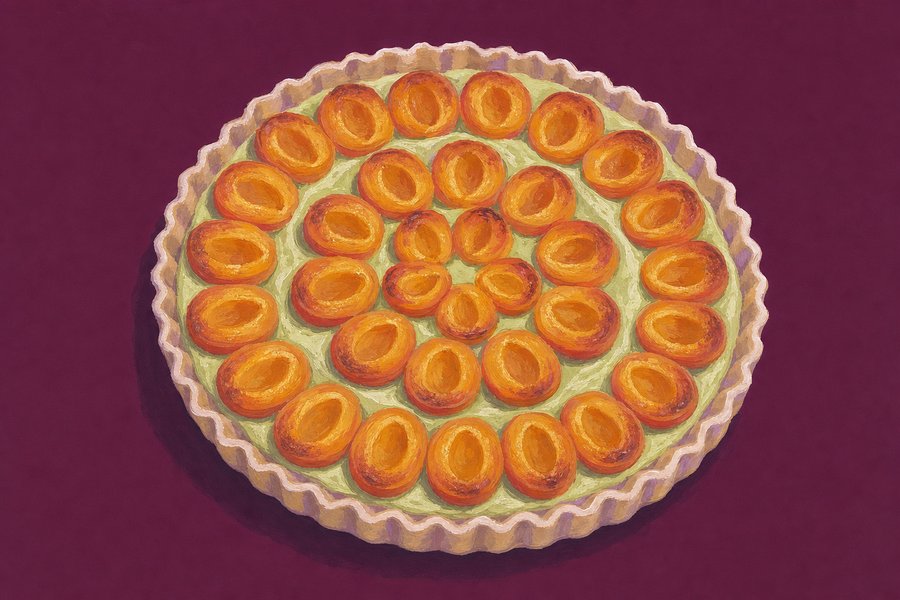
Set group 3 in a tart tin
In a jam, group 3 means: this fruit will not gel on its own, so add pectin or acid. In a tart it means something adjacent and more immediately visible: the fruit will not hold itself together as it bakes. Low pectin is exactly the property that lets cooked fruit collapse into liquid rather than staying as recognisable pieces in a sauce that clings.
Combine that with 86.35 g of water per 100 g and the outcome is predictable: apricots baked on a shell release a good deal of liquid and do not thicken it themselves. That is not a fault in the fruit; it is what the register said would happen, read across.
The dough recorded as strong enough to hold a liquid filling without leaking is pâte sucrée, bound with egg and described as tight, crisp, cookie-like, specified at pâte sucrée and pâte sablée. Which is why an apricot tart is conventionally built on the sucrée rather than the sablée, and why the choice is a structural one rather than a matter of taste.
What the pistachio is doing
A ground-nut layer between the shell and the fruit, a pistachio cream or frangipane, is the standard answer to this problem, and it is worth being clear about what it does. It is not a flavour pairing that happens to be traditional. It is an absorbent, egg-set layer sitting exactly where the fruit’s water would otherwise meet the pastry.
Pistachio itself is outside the register entirely, for the same reason chestnut is: it is a nut, and the sugar, acid and pectin readings that describe a fruit do not describe it. Nothing consulted here gives figures for it, so none are given.
The three preserving conditions, and which fruits supply them unaided, are at preserves.
Questions about apricot tarts
Why do apricots make a tart wet?
Because of two readings in the register: low pectin and 86.35 g of water per 100 g. Low pectin is what lets cooked fruit collapse into liquid instead of holding together, and there is a lot of liquid to release.
What does set group 3 mean for a tart?
In a jam it means the fruit needs added pectin or acid to gel. In a tart it means the same property shows up differently, in that the fruit will not hold itself together as it bakes.
Which pastry should an apricot tart use?
Pâte sucrée. It is the one the tart-dough dataset records as strong enough to hold a liquid filling without leaking, which is a structural choice here rather than a preference.
What is the pistachio layer for?
It is an absorbent, egg-set layer placed exactly where the fruit’s water would otherwise reach the pastry. The flavour pairing is real, but the layer is doing structural work.
Is apricot acidic enough to can?
Not reliably. Its measured range, 3.3 to 4.8, straddles the 4.6 line, so an individual fruit may fall either side of it and it should be treated as needing acidification.