What the numbers say
A preserve sets when three things line up: enough sugar, enough acid, and enough pectin. The register measures all three across thirty-four fruits. Cucumber is not one of them, being a vegetable in every kitchen sense, but the same readings exist for it, and placing it against the register is instructive.
Its measured pH is 5.12–5.78, and the whole of that range sits above the 4.6 line. Not straddling it, the way apricot and mango do: entirely above. Of the thirty-four fruits in the register only fig and honeydew melon can say the same.
Its sugar is 1.67 g per 100 g, which would place it second-lowest of the 28 fruits with a measured figure, between rhubarb at 1.1 and lime at 1.69. And at 95.23 g of water it is wetter than anything in the register; rhubarb, the wettest of the thirty-four, is 93.61. Its pectin is not established.
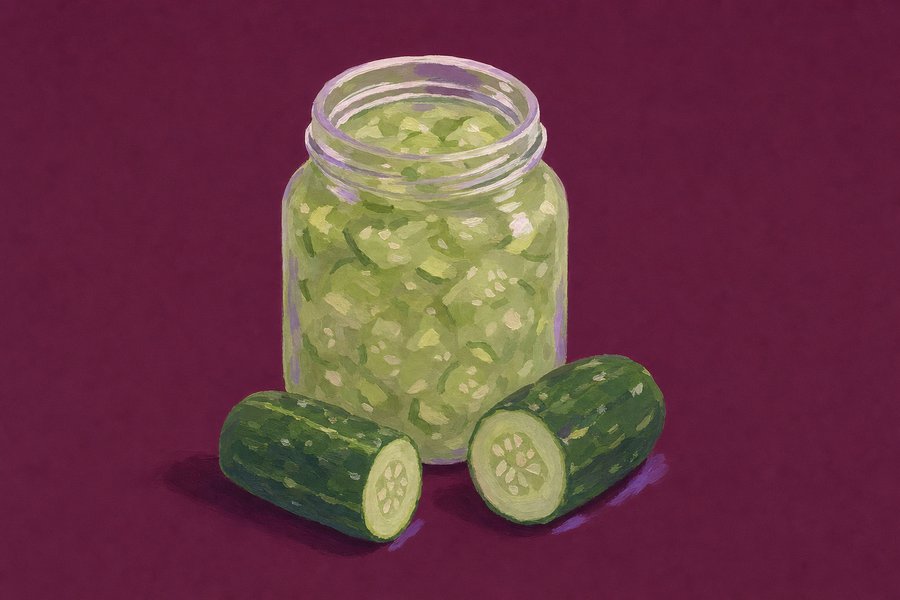
So the jam is made of what you add
Put those together and the conclusion is unusually clean. Cucumber brings almost no sugar, almost no acid, and an unknown and probably small amount of pectin, carried in a great deal of water. Every one of the three conditions has to come from outside it.
Which is not an argument against making it. It is an argument for reading the recipe differently: the sugar is not there to concentrate the cucumber’s own sweetness, because there is very little to concentrate. The lemon is not adjusting the acidity, it is supplying it. And the water has to leave before anything can set, which is why every version of this preserve involves standing the cut cucumber in sugar, or a long slow reduction, or both.
What the cucumber contributes is texture and a light, faintly green flavour that survives being cooked in sugar, and that is a real reason to make it. It is simply not doing the structural work.
The same cucumber, three times, at three different pH
There is one more thing in the FDA table worth pulling out, and it is the clearest illustration of a principle this site keeps returning to. That table lists this one vegetable three times:
Cucumbers at 5.12–5.78. Cucumbers, pickled at 4.20–4.60. Cucumbers, Dill pickles at 3.20–3.70.
Same plant, three entries, and the second and third have crossed the 4.6 line that the first sits entirely above. Nothing about the cucumber changed; what changed is what was done to it. pH is a property of the preparation, not of the ingredient, which is why the register gives ranges for raw fruit and why a figure taken from a processed entry cannot be substituted for a fresh one.
The three conditions, and the fruits that supply them without help, are set out at preserves. The terms used across this site are in the glossary.
Questions about cucumber jam
Will cucumber jam set on its own?
No. Its whole measured pH range sits above the 4.6 line, its sugar is among the lowest of any measured fruit, its pectin is not established, and it carries more water than anything in the register. All three setting conditions have to be supplied.
Is cucumber acidic?
Not by preserving standards. Its measured range is 5.12–5.78, entirely above the 4.6 acidified-foods line, so acid has to be added rather than adjusted.
Why does every recipe start by salting or sugaring the cucumber?
Because of the water. At 95.23 g per 100 g it is wetter than any fruit in the register, and that water has to leave before anything can set. Standing it in sugar, a long reduction, or both, is how that happens.
Why does the FDA table give three different pH values for cucumber?
Because it lists three preparations: raw at 5.12–5.78, pickled at 4.20–4.60 and dill pickles at 3.20–3.70. Nothing about the plant changed, because pH belongs to the preparation, not to the ingredient.
How much pectin does cucumber have?
Not established. No source consulted publishes a pectin figure for it, so the register leaves the field empty rather than estimating one.