The list
10 tools, grouped by what they do. The French term is given first because it is the one that is precise: English pastry vocabulary has borrowed unevenly, and in two cases the same English words are used for two different objects.
| French | In English | What it is for |
|---|---|---|
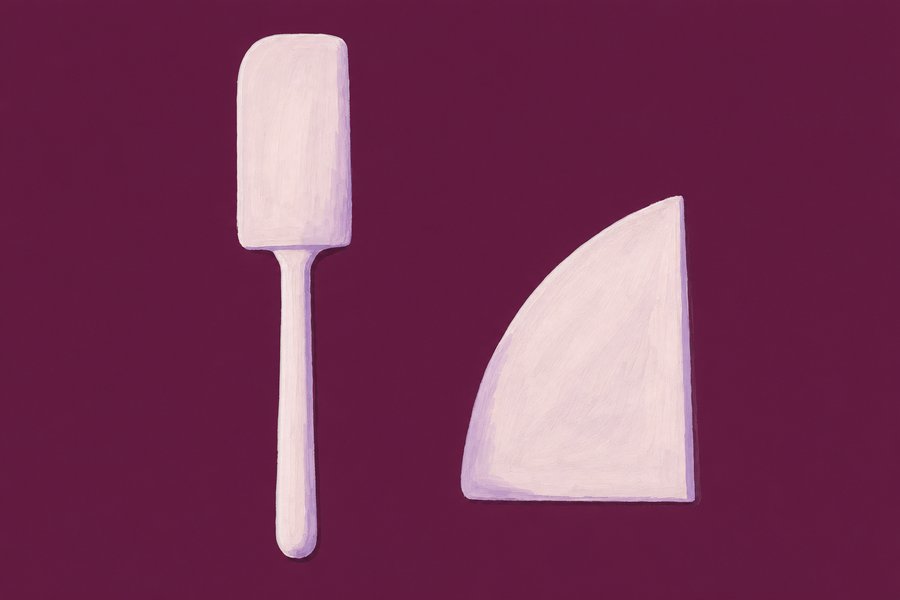
| maryse | rubber spatula, rubber scraper, silicone spatula, bowl scraper | A flexible spatula with a soft blade, used to fold, scrape a bowl clean and mix without knocking air out of a batter. |
| corne | bowl scraper, dough scraper, plastic scraper | A stiff handleless plate, usually one curved edge and one straight, for scraping dough out of a bowl and off a bench. Often confused with a maryse - the corne has no handle and does not flex the same way. |
| fouet | whisk, balloon whisk | Looped wires on a handle, for aerating and emulsifying. |
| cul-de-poule | mixing bowl, round-bottomed bowl | A hemispherical bowl - the round base leaves no corner a whisk or maryse cannot reach. |
| French | In English | What it is for |
|---|---|---|
| palette coudee | offset spatula, angled palette knife | A blade stepped down from the handle so the hand clears the work, for spreading and smoothing. |
| palette | palette knife, straight spatula | A long flat unstepped blade for spreading and lifting. |
| corne a decor | comb scraper, decorating comb | A scraper with a toothed edge, for combing lines into cream or chocolate. |
| pinceau | pastry brush | A brush for glazing, egg-washing and brushing off excess flour. |
| French | In English | What it is for |
|---|---|---|
| chinois | conical strainer, chinois | A fine cone-shaped strainer for passing creams and coulis to remove lumps and seeds. |
| French | In English | What it is for |
|---|---|---|
| rouleau a patisserie | rolling pin | A cylinder for rolling dough to an even thickness. |
The two confusions
A maryse is not a corne. Both get called a bowl scraper in English, and they do not do the same job: a maryse is a flexible blade on a handle, for folding and for scraping a bowl without knocking air out; a corne is a stiff handleless plate with one curved edge, for getting dough off a bench. One flexes and one does not, which is the entire difference. The maryse page takes that apart in French.
A palette is not a palette coudée. A palette is flat and straight; a palette coudée is stepped down from the handle so the hand clears the work. English calls the second one an offset spatula and the first one a palette knife, and then uses “spatula” for both, and for the maryse as well.
Heat limits, where a manufacturer states one
1 of the 10 carry a published heat limit. The rest are steel or rigid plastic used cold, and no figure is given for them here rather than a guessed one.
- maryse: 220-260 °C. Traditionally rubber; professional versions are one-piece ("monoblock") food-grade silicone, which is preferred under HACCP because there is no handle joint to trap product.
That figure matters mostly for the silicone tools, which are the ones left resting in a hot pan. The range is a manufacturer's specification rather than an independent test, so it is quoted as a range and attributed rather than narrowed to one number.
What is not on this list
Pans and tins are a different question, and turn on capacity rather than on naming. Round cast-iron sizes, with the stamped numbers and lid letters explained, are at casserole sizes, and the section overview is kitchen. Words that are ingredients or products rather than tools are in the glossary.
Questions about pastry tools
What is a maryse?
A flexible spatula with a soft blade, used to fold and to scrape a bowl clean without knocking the air out of a batter. Professional ones are one-piece silicone, because a handle joint traps product.
What is the difference between a maryse and a corne?
The maryse flexes and has a handle. The corne is a stiff handleless plate with one curved edge, for scraping dough off a bench. English calls both a bowl scraper.
What is a palette coudée?
An offset spatula: the blade is stepped down from the handle so your hand clears the work while spreading. A plain palette is straight and unstepped.
How hot can a silicone spatula get?
Manufacturers specify 220 to 260 °C for food-grade silicone maryses. That is a manufacturer figure rather than an independent test, which is why it is quoted as a range.
What is a cul-de-poule?
A round-bottomed mixing bowl. The round base is the point: a whisk reaches the whole of it, so nothing sits unmixed in a corner.