Which fondant this is
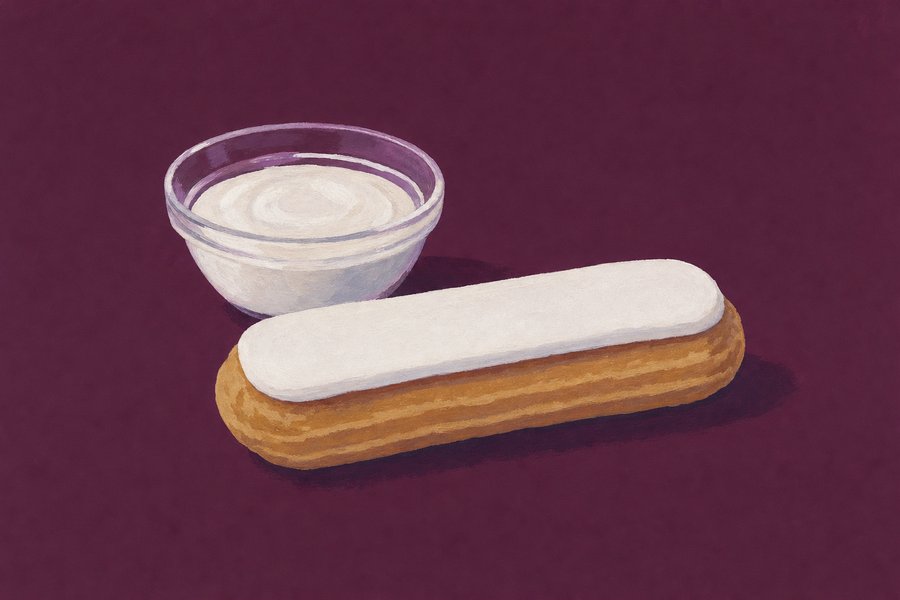
A white poured glaze, warmed to a flowing consistency, used on eclairs and mille-feuille. Also called fondant blanc or poured fondant. It is the opaque, faintly shiny white top on an éclair or a mille-feuille, and it is the least known of the three things called fondant in English.
It is not the rolled sugar covering draped over celebration cakes, and it is not fondant au chocolat, which is a cake. The three share a name and nothing else, and the disambiguation is at fondant meaning. Everything below is about the poured glaze only.
On the word itself: A pastry chef. Feminine: patissiere. The trade, and the root of "creme patissiere" - literally the pastry chef's cream. So fondant pâtissier is the pastry chef's fondant, in the same way that crème pâtissière is the pastry chef's cream. The name marks it as trade material rather than home decoration, which is roughly right. It is far more common in professional kitchens.
The temperature, which is the whole technique
Working temperature: warm to about 37 C and NEVER above it - past 37 C it loses its shine. Some references work it at ~32 C with a little sugar syrup. Loosen with syrup, not water, if it is too stiff; stir with a spatula, never a whisk.
Set out plainly: warm it to about 37 °C and never above. Past that it loses its shine and dries dull, and the loss is not recoverable. No amount of reheating or stirring brings the gloss back, so an overheated batch is only useful where appearance does not matter. Some references work it cooler still, around 32 °C, with a little sugar syrup to keep it flowing.
The margin is narrow enough that this is one of the few places in pastry where a thermometer earns its place. Thirty-seven degrees is barely warm to the touch, roughly blood heat, and the instinct to warm it until it flows easily is precisely the instinct that ruins it.
Loosen it with syrup, not with water
The other rule that matters. When the fondant is too stiff to pour, the reflex is to add water, and water does thin it, while taking the gloss with it, because it dilutes the sugar concentration the shine depends on. Loosen with sugar syrup instead: it thins the mass without changing what the mass is.
That is also why fondant keeps reasonably well and is worth making or buying in quantity. A tub of it stiffens as it stands and is brought back with syrup and gentle warmth, indefinitely, as long as neither step is overdone.
Why it looks the way it does
Fondant's opacity is not a pigment. It is a controlled crystallisation: the sugar is worked as it cools so that it sets as a very large number of very small crystals rather than a few large ones, and it is that fine crystal structure that scatters light and reads as opaque white. The same physics makes it smooth on the tongue rather than gritty.
Heating past the point where those crystals redissolve is what destroys the finish, which is the mechanism behind the temperature rule. It is not that the fondant is scorching at 40 °C; it is that the structure responsible for the appearance is coming apart, and it does not reform the same way on cooling.
Two practical consequences of that mechanism. Warm fondant gently in a bowl over water rather than directly on heat, because a hot spot at the base of a pan takes that portion past the threshold while the rest is still cool. And stir it as little as possible once warm: agitation encourages the small crystals to find each other and grow, which is the other route to a dull finish.
Colouring behaves the same way as thinning. A water-based colour dilutes the sugar concentration exactly as plain water does, so a strongly coloured fondant gives up some shine; a paste or fat-soluble colour costs less of it.
The rest of the borrowed vocabulary is collected in the glossary.
Questions about poured fondant
What is fondant patissier?
A white poured glaze, warmed to a flowing consistency and used on éclairs and mille-feuille. Also called fondant blanc or poured fondant. It is not the rolled cake covering and not the molten chocolate cake.
What temperature should white fondant be worked at?
About 37 °C and never above, so barely warm to the touch. Some references work it around 32 °C with a little sugar syrup. Above roughly 37 °C it loses its shine permanently.
My fondant dried dull. Can I fix it?
No. The gloss depends on a fine crystal structure, and once that has been broken by overheating it does not reform on cooling. The batch is still edible but will not shine.
How do I thin fondant that is too stiff?
With sugar syrup, not water. Water thins it but dilutes the sugar concentration the shine depends on, so it takes the gloss with it.
Why is fondant white rather than clear?
Because it is crystallised deliberately fine. A very large number of very small sugar crystals scatters light, which reads as opaque white and also feels smooth rather than gritty.