What is pate sucree?
Most of what a pate sucree recipe specifies follows from one choice, made before any quantity. The direct answer to what is pate sucree: a sweet French tart pastry, made by creaming butter and sugar together before the egg and flour go in, which produces a tight, crisp, cookie-like crumb. It carries more sugar and less butter than its nearest relative, and it is the dough of the three that is strong enough to hold a liquid filling without leaking.
What is pate sucree for is the more useful question, and the answer is any tart whose filling is wet when it goes in: lemon, custard, frangipane, a set cream. The strength comes from the method rather than the sweetness, which is the point most often missed.
Pate sucree vs pate sablee
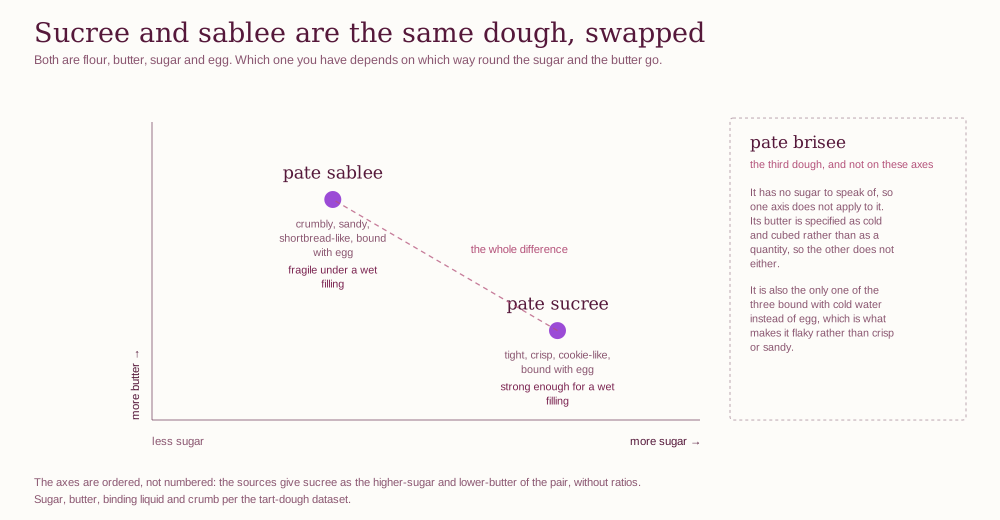
The comparison people actually want is pate sucree vs pate sablee, and the two differ in both directions at once. Sucrée has the higher sugar and the lower butter; sablée has the lower sugar and the higher butter. But the ratio is the smaller half of the difference.
The larger half is method. Sablée is always made by sablage, in which the fat is rubbed into the flour first, so every particle of flour is coated and gluten cannot develop. That is what makes it sandy and shortbread-like, and it is also what makes it fragile. Sucrée is normally made by crémage, creaming the butter and sugar, which allows some structure to form. Set out as pate sucree vs pate sablee, the practical consequence is simple: sucrée holds a wet filling and sablée is weaker and more likely to leak.

| Dough | Sugar | Butter | Liquid | Method | Crumb | Holds a wet filling |
|---|---|---|---|---|---|---|
| pate brisee | none or minimal | cold, cubed | cold water | Cold butter cut into flour until flaky, then water added a little at a time. | Flaky, layered | Moderate |
| pate sucree | HIGHER than sablee | LOWER than sablee | egg | Creaming (cremage) - butter and sugar creamed, then egg, then flour. Can also be made by sablage. | Tight, crisp, cookie-like | YES - strong enough to hold a liquid filling without leaking |
| pate sablee | LOWER than sucree | HIGHER than sucree | egg | ALWAYS sablage - fat rubbed into the flour first so each particle is coated and gluten cannot develop. | Crumbly, sandy, shortbread-like | Weaker - fragile |
Pâte brisée is the third and the odd one out: barely sweetened, cold butter cut in rather than creamed, and flaky rather than crisp. It is a savoury-leaning dough that happens to sit in the same family.
What a pate sucree recipe is really specifying
Read against the table, a pate sucree recipe is making three decisions on your behalf. The sugar quantity, which sets the crispness and the colour. The choice of creaming or sablage, which sets the strength. And the resting time, which is not in the table because it is not an ingredient, but which matters as much as either: a creamed dough has developed some gluten and needs a cold rest for it to relax, or the case shrinks down the sides of the tin as it bakes.
A pate sucree recipe that gives a resting time in hours rather than minutes is not being fussy. That is also why some published versions specify sablage for a sucrée dough as an alternative route: it trades a little strength for a dough that shrinks less and handles more easily.
The other reason to read the method rather than the ingredient list is that the ratios overlap. There are published sucrée and sablée recipes whose sugar and butter quantities are close enough to be interchangeable, and which nonetheless behave completely differently, because one creams and one rubs.
Pate sucrée Pierre Hermé, and other named versions
Searches for pate sucrée Pierre Hermé are looking for a specific published formulation. Pierre Hermé is a French pâtissier who has published his own version of the dough, and it is referenced here as his work rather than reproduced: anyone wanting that formulation should go to his published books, where it appears with his own notes and quantities.
The general point is worth making, though, and it applies beyond any one formulation. Whether the version sought is pate sucrée Pierre Hermé or another chef's, named versions of the dough differ mostly in sugar type and in how much almond flour is present, and both changes push the dough in the same direction: finer, shorter, more fragile, more biscuit than pastry. A named version is usually a deliberate step away from strength and towards texture, which is a reasonable trade for a tart that does not need to hold liquid.
Using it in a tart
A sucrée case in a tart normally wants blind baking, and whether it is partial or full depends on the filling rather than the dough, and the temperatures and times are in the blind-baking specification. Because sucrée is the strongest of the three, it tolerates a shorter partial bake than a sablée case would.
For a tart with a set cream rather than a baked filling, the case is fully baked and cooled first, and the filling choice is its own decision, between a filling that holds overnight and one that slumps is set out in the pastry cream family.
Questions about the tart doughs
What is pate sucree?
A sweet French tart pastry made by creaming butter and sugar before adding egg and flour, giving a tight, crisp, cookie-like crumb. It carries more sugar and less butter than pâte sablée, and it is the dough strong enough to hold a liquid filling.
Pate sucree or pate sablee for a lemon tart?
Sucrée. It is made by creaming rather than by sablage, so it develops enough structure to hold a wet filling. Sablée has the fat rubbed into the flour first, which prevents gluten forming: sandy and delicious, but more likely to leak.
Why does my tart case shrink down the sides?
A creamed dough has developed some gluten, and gluten contracts in the oven unless it has relaxed first. The usual cause is too short a cold rest before baking, or rolling and lining while the dough is still warm.
What is sablage?
Rubbing the fat into the flour before any liquid, so each particle of flour is coated and gluten cannot develop. It is what makes a sablée dough sandy, and what makes it fragile. Crémage, creaming the butter and sugar first, is the alternative route.
How is pate brisee different from both?
It is barely sweetened, its butter goes in cold and in pieces rather than creamed, and its liquid is water rather than egg. That gives a flaky, layered crumb instead of a crisp one, and it leans savoury.